Sports
oi-Prakash KL

They ran faster than Usain Bolt. Then, some of them had to be carried off on stretchers.
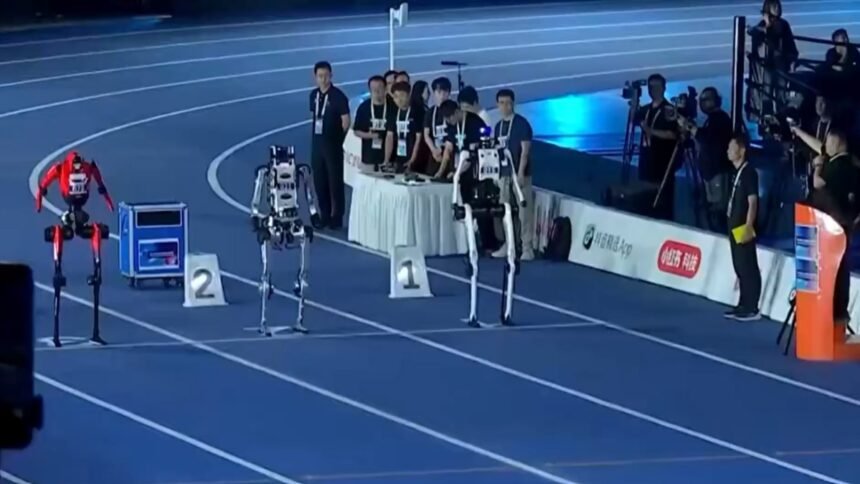
At the World Humanoid Robot Games in Beijing on August 22, a Chinese-built robot named Tiangong Ultra clocked 9.39 seconds in the 100-meter preliminary round-nearly two-tenths of a second faster than Bolt’s legendary 9.58-second world record set back in 2009. The machine, developed by the Beijing Humanoid Robot Innovation Center, didn’t just beat the fastest man alive on paper. It made him look, well, human.
At the August 22 World Humanoid Robot Games in Beijing, robots like Tiangong Ultra achieved speeds faster than Usain Bolt’s 100m record, while another robot set a new high jump record, demonstrating advancements in China’s strategic robotics initiatives.

But Tiangong Ultra wasn’t alone on the track. Honor, the Chinese smartphone maker better known for its handsets than its hardware, entered a robot called Lightning. It finished just behind in 9.47 seconds.
This was the second edition of the games, and the events went far beyond sprinting. The five-day competition, held at the National Speed Skating Oval built for the 2022 Winter Olympics, featured over 50 events and more than 1,000 contests. Robots played football, connected cables, charged electric vehicles, and hauled materials from one spot to another. It’s not just for show-organizers say these tasks test how well bots can handle the messy, unpredictable real world that humans navigate with ease every day.
And while the human body remains a marvel of evolution-moving through chaos while processing input from every sense-the robots are catching up fast. China has pinned humanoid robotics as a strategic emerging industry, betting that breakthroughs in AI and hardware will soon put these machines to work in factories, warehouses, and even homes.
Lightning, the Honor-built sprinter, had already proven its endurance earlier this year. In April, it won the 21-kilometer Beijing half marathon in 50 minutes and 26 seconds, a pace faster than the elite men’s human world record. Back then, the robot stood 169 centimeters tall with 95-centimeter legs. For the games, researchers stretched its legs to 105 centimeters, according to state broadcaster CCTV.
Then there was the standing high jump. A humanoid robot cleared 2.88 meters-crushing the 0.95-meter mark from last year’s games and soaring past Javier Sotomayor’s human world record of 2.45 meters, which has stood since 1993. Both record-setting jumpers came from Beijing-based X-Humanoid. But here’s the twist: after smashing into the wall on landing, they too needed a stretcher. Bolt, by contrast, just jogged a victory lap.
More than 2,000 humanoid robots took part in this year’s games, according to the organizers. The event ran the same week as Beijing hosted the 2026 World Robot Conference, where around 3,000 products-many of them humanoid-were on display. China now manufactures the majority of the world’s humanoid robots, and with the tech race against the U.S. heating up, the country is making sure everyone knows it.
With inputs from agencies