

Scientists at the University of Groningen in the Netherlands have discovered how tin-based perovskite materials allow hot electrons to retain their excess energy for around 1,000 times longer than expected, a finding that could shape the future of solar power. The researchers found that two physical effects, the hot phonon bottleneck and the Burstein–Moss effect, work together to slow electron cooling from picoseconds to nanoseconds. Published in ACS Energy Letters, the study addresses a major challenge in solar energy, where excess electron energy is typically lost as heat before it can be converted into electricity. The findings could support the development of hot-carrier solar cells designed to reduce thermalisation losses and improve solar conversion efficiency.
How Dutch scientists uncovered the secret behind longer-lasting hot electrons
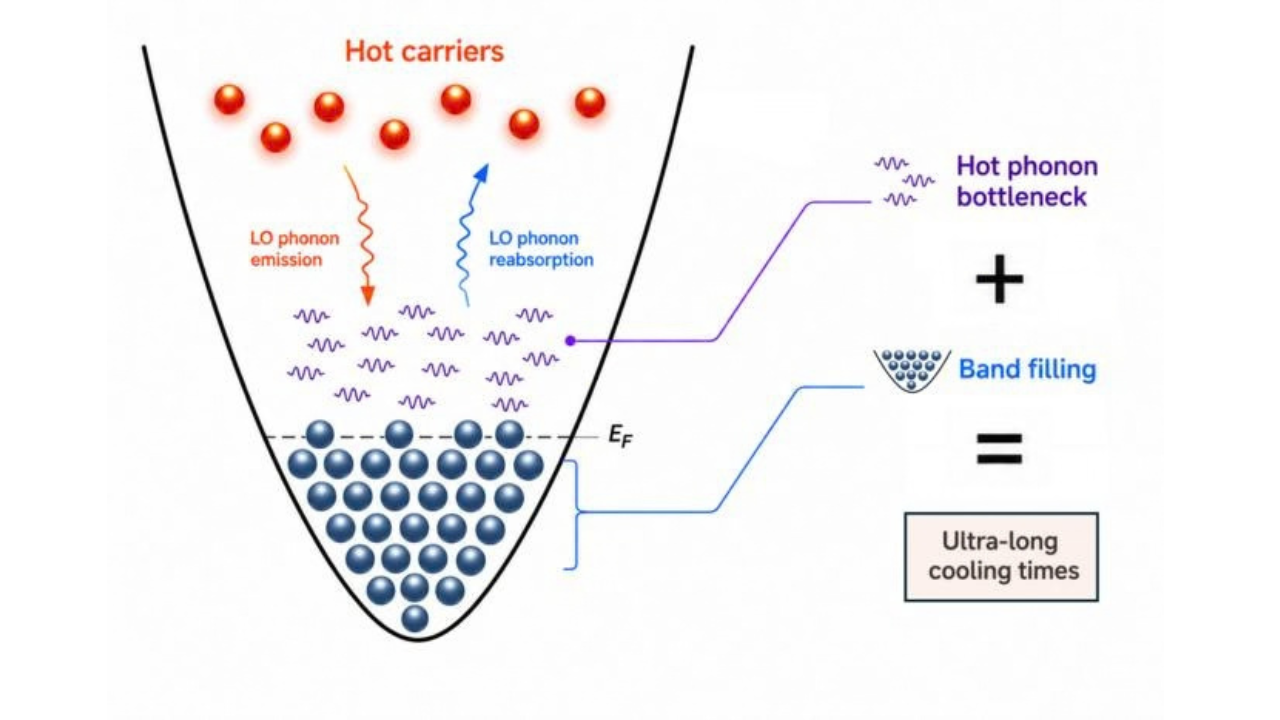
The research began with experiments led by Maria Antonietta Loi, whose team was studying the behaviour of excited charge carriers in tin-based perovskite materials. These materials are being investigated for their potential use in solar cells and other optoelectronic technologies. During the experiments, Loi’s team observed that hot electrons retained their excess energy for much longer than expected, with cooling occurring over nanoseconds instead of the picosecond timescale typically associated with hot-carrier relaxation.The unexpected results raised questions about the physical processes responsible for the unusually slow cooling. L. Jan Anton Koster and doctoral researcher Tim Faber used computer simulations to investigate how electrons transfer energy within the material and determine why the cooling process was taking so long.Koster explained the challenge of interpreting the experimental findings, saying, “The measurements were clear, but we didn’t understand the physics behind this.” He added, “We even started to doubt the measurements ourselves.”The researchers first examined the hot phonon bottleneck, a mechanism that can slow energy loss through interactions between electrons and lattice vibrations. However, the process alone could not explain the cooling times observed by Loi’s team. The researchers then incorporated band filling, which is associated with the Burstein–Moss effect, into their simulations. This combination produced cooling times in the nanosecond range, matching the experimental observations.
Why hot electrons matter for solar energy
When sunlight strikes a solar-cell material, its energy excites electrons and moves them into higher energy states. These electrons initially carry more energy than they need to contribute to electricity generation. In conventional solar cells, much of this excess energy is released as heat before it can be converted into usable electricity.This energy loss is known as thermalisation. It is one of the factors that limits the efficiency of traditional single-junction solar cells. Hot-carrier solar cells are being studied as a possible way to capture excited electrons before they lose their excess energy.By preserving more of the energy absorbed from sunlight, these devices could potentially improve solar conversion efficiency and move beyond the theoretical limits associated with conventional single-junction cells.
How the hot phonon bottleneck affects energy loss
The first mechanism examined by Koster and Faber was the hot phonon bottleneck. When hot electrons release energy, some of it is transferred to vibrations in the material’s crystal lattice. These vibrations are known as phonons.As energy accumulates in the lattice, electrons may reabsorb some of the energy previously released through interactions with these phonons. This repeated exchange slows the rate at which electrons lose their excess energy and delays the cooling process.The researchers included this mechanism in their simulations to determine whether it could explain the unusually long cooling times. Although the hot phonon bottleneck slowed energy loss, it did not produce cooling times long enough to match the experimental results.Koster explained, “When we added this well-known process called Hot Phonon Bottleneck to the simulations, it slowed the loss of energy, but not enough to explain our measurements.”The result suggested that another physical process was contributing to the extended cooling period.
How the Burstein–Moss effect slows electron cooling
The researchers next examined band filling, a process associated with the Burstein–Moss effect. Hot electrons lose energy by moving from higher energy states to lower ones. However, when lower energy states are already occupied by other electrons, some of the pathways normally available for energy loss become restricted.This limits the ability of hot electrons to move into lower energy states, slowing their cooling. In the tin-based perovskite material, band filling worked alongside the hot phonon bottleneck to extend the energy-loss process.When the researchers incorporated both mechanisms into their simulations, the model produced cooling times in the nanosecond range. The results were consistent with the observations made during Loi’s experiments.Koster said, “When we added this process to the simulation as well, we saw that energy loss was now in the nanosecond range, as seen in the experiments by Maria Loi.”The combined effect of the two mechanisms helped explain how the material could retain hot electrons for much longer than expected.
What the study reveals about tin-based perovskites
The study, titled The Physics of Ultra-Long Cooling Times in Metal Halide Perovskites, examines the physical processes behind unusually long hot-electron cooling times in tin-based perovskite materials.The researchers found that the hot phonon bottleneck and band filling contribute to the extended cooling period in different ways. The hot phonon bottleneck involves energy exchange between electrons and lattice vibrations, while band filling restricts the electronic states available for energy loss.Together, these effects provide an explanation for the nanosecond-scale cooling observed in the experiments. The findings also show how theoretical simulations can help researchers interpret experimental results that initially appear difficult to explain.Understanding these mechanisms could help scientists investigate how the energy-retention properties of perovskite materials can be controlled and used in future photovoltaic technologies.
Could the discovery lead to more efficient solar panels?
Hot-carrier solar cells aim to collect electrons while they still retain excess energy, reducing the amount of energy lost through thermalisation. The longer cooling times observed in the tin-based perovskite material could offer researchers a greater opportunity to study how this excess energy might be extracted.The University of Groningen study provides insight into the material properties and physical mechanisms that could support the development of such technologies. However, extending hot-electron cooling times does not automatically guarantee a more efficient solar cell. Researchers must also find effective ways to extract the retained energy and convert it into electricity.Future work will focus on understanding how these findings can be applied to practical device designs. The study offers a clearer explanation of long-lasting hot electrons and provides a foundation for further research into solar materials that could reduce thermalisation losses and improve energy conversion.