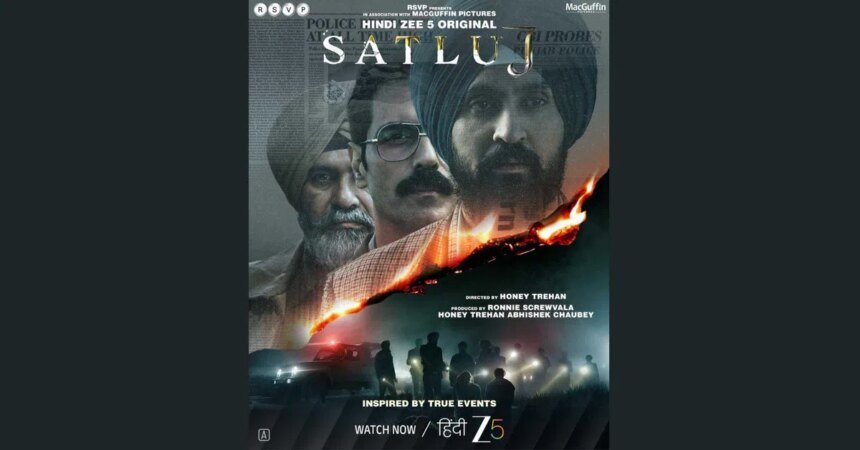
In this era of conspiracy theories, everybody in Punjab seems to have their own “insight” into this. If the Bharatiya Janata Party (BJP) wanted to stop the film, as the Central Board of Film Certification’s 127 proposed cuts showed, it could’ve easily made sure Zee wouldn’t release it. It’s also owned by somebody close to it politically.
Then, why would he pull it in 48 hours? Everybody would’ve known that once out in digital form, it will be shown widely. If anything, the controversy will give it more fire and fury. The buzz in Punjab, headed for elections early next year, is: Who benefits the most from this controversy? Or who will it hurt the most? As usually happens, one outcome leads to the other.
Let’s list four things the film does.
One, by focusing on just the man who investigated “fake” encounters after the militancy was over, it’s playing into a generation-old grievance. The film will rekindle fresh anger with its revisionism.
Two, in a hardly subtle way, there is heroism bestowed upon the militants. Watch the way the August 31, 1995 human-bomb assassination of chief minister Beant Singh is portrayed. In the background plays the foremost Sikh verse of martyrdom in battle.
Three, while it is bound to anger many younger Sikhs with no lived experience of the decade of terror, those particularly affected will be the Jats (‘Jutt’ in Punjab), especially among the more religious and conservative sections. A critical mass of them, in terms of a percentage of overall demographics or voter base, live in Punjab’s border districts and traditional strongholds of the Shiromani Akali Dal (SAD).
And four, overtly the film is so apolitical as to be anodyne. It’s as if this was a private war between the militants and the police. We only know the demographic it is bound to trigger the most. They’re the relatively conservative sections of the Jutt Sikhs, especially in rural constituencies.
Where might their vote go as a result? The Shiromani Akali Dal, which has traditionally owned this vote, has been on the ropes already. In the 2024 Lok Sabha elections, it lost the Tarn Taran/Khadoor Sahib constituency to jailed radical Amritpal Singh by a huge margin. The radicals got another seat, Faridkot, won by Sarabjeet Singh Khalsa, the son of Delhi cop Beant Singh, who was one of Indira Gandhi’s two assassins.
This mass of voters was already angry, disaffected from their mainstream politicians, and especially the Akalis. It is unlikely that the same voter, further angered by Satluj, will return to the Akali Dal. They are even more likely to stay with the radicals. And because this conservative mass will almost definitely not go to the Congress or the Aam Aadmi Party (AAP), there is only one party that benefits.
See it like this. Power in Punjab has rotated among three entrenched political forces: The Congress, Akali Dal, and AAP. The radicals are the fourth, if limited.
Even to be a coalition partner, the radicals will need the Akalis to win a third of the seats, an improbability. For the Akalis, with their “believers” vote split, they can be driven to further marginalisation. The AAP has to deal with anti-incumbency and attacks from the Sikh clergy. The Congress is fighting with itself. In this melee, if the Hindu vote consolidates, only the BJP benefits.
See Punjab politics through its demographics. Contrary to folklore, Punjab isn’t a Sikh state. The Sikhs, at 58 per cent are a majority, but Hindus, at around 40 per cent, are significant. If the Sikh vote fractionalises and the Hindus come together, the state could take an unimagined turn.
We can cut and dice this further. Of the Sikhs, about 60 per cent are Jutts, say, about one-fourth of the state’s overall population. They form the bulk of the Akali, radical and anti-Congress vote. If more of it shifts to the radicals, it decimates SAD-Akali Dal and benefits AAP or the Congress. The BJP wants to consolidate the Hindus, as in West Bengal and Assam.
If they get 70 per cent of the Hindu vote, they’re in business in what will then become a five-way split.
A relatively under-appreciated factor is the Dalit vote in Punjab. It is widely, and quite reliably, estimated at 33 per cent, Sikh and Hindu. They are 35 per cent of the Sikhs. Traditionally, the Congress had a foothold there, and the AAP cut into it. An important point is the sway that the many babas and deras have on this vote bank. That’s why rape convict Gurmeet Ram Rahim gets paroles on the eve of any polling, even a panchayat election. The BJP has built this constituency for long.
Next week, the Prime Minister visits Punjab. He will go to Jalandhar to inaugurate the new railway station, but the really politically significant move will be his expected visit to Dera Sachkhand Ballan, the “seat” of Sant Niranjan Dass ji. He’s the spiritual leader of the Ravidassia Dalit community. We do not know the split, but the larger community, of what will be described as Jatavs in the Hindi heartland, constitutes just about half of all Dalits in Punjab. In this Republic Day’s list of honours, Sant Niranjan featured with a Padma Shri. You can add two and two.
Next step is electoral data. After the break of the old alliance with SAD over farm Bills, the BJP decided to go alone in Punjab. It was arrogant and suicidal, it was widely thought.
Sure enough, in the 2022 Assembly elections, it got just 6.6 per cent. But in the 2024 Lok Sabha polls, it went up to 18.65 per cent. It sounds even more impressive given that the Congress and AAP were at around 26 per cent each, and the Akalis were reduced to 13.48 per cent as conservative Sikh vote moved to the radicals. They are looking down the barrel now. You can understand why they are organising shows of Satluj in “every village” of the state.
The BJP is hoping if they can go up to 30 per cent vote, max out in the 55 constituencies where Hindus have significant presence, and have the deras deliver the Dalits, they can be the largest party. It looks like simple enough arithmetic, and to that extent, it might see the risk of a fresh wave of radicalisation worth its while. For sure, it would believe it will put it down quickly, and so what if another Satluj-like film is made 30 years later. We need to note that while the Akalis are celebrating Satluj and others are quiet, it is only the BJP’s Ravneet Singh Bittu who’s attacking it. You might credit this on his being former chief minister Beant Singh’s grandson, but if you think any BJP leader goes out on a limb without the party’s approval, you must be naive.
Nobody can be sure, but this would look like the most logical explanation for this dramatic Satluj release and withdrawal on Zee5. It is just that Punjab’s voters can also surprise us. The Satluj protagonist, Jaswant Singh Khalra’s wife, contested for Lok Sabha from Tarn Taran/Khadoor Sahib twice. In 1999 for a breakaway Akali Dal faction when she lost her deposit, and then in 2019 to finish third, with the Congress winning the most “religious Sikh” seat in the state. In 2019, she was fielded by Punjab Ekta Party that Sukhpal Singh Khaira formed after breaking away from the AAP. Khaira is now in the Congress and among its most vocal leaders. All of this, just in case you thought only Bihar’s politics was complicated.
By special arrangement with ThePrint