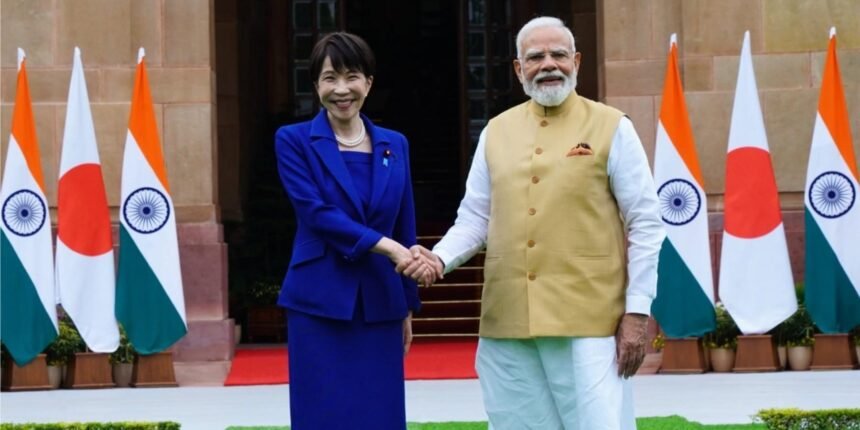
India and Japan on Thursday signed agreements to deepen cooperation in economic security, clean energy, artificial intelligence (AI), defence technology, health care and maritime security. This came after summit talks between Prime Minister Narendra Modi and his Japanese counterpart Sanae Takaichi.
Takaichi is on a three-day official visit to India from July 1 to 3 at the invitation of PM Modi.
Addressing a joint press briefing after the talks in New Delhi, PM Modi said the two countries had prepared a joint roadmap for economic security at a time of global uncertainty. The roadmap will focus on strengthening supply chain resilience in strategic sectors such as semiconductors, quantum technology and advanced materials.
“In today’s era of uncertainty, both India and Japan fully understand the importance of economic and energy security,” PM Modi said.
AI, defence technology cooperation
AI, defence technology cooperation
The two sides also announced a joint statement on cooperation in the field of AI, signalling a stronger focus on technology collaboration.
PM Modi said he and Takaichi believed that technology partnership would become the strongest pillar of India-Japan cooperation.
“The convergence of Japan’s precision technology and India’s software capabilities will impart new momentum and strength to global AI development,” he said.
In defence, India and Japan signed an agreement on their first co-development project, involving the naval radio antenna “Unicorn”. PM Modi said the project would open a new chapter in defence technology partnership.
“We will now jointly develop defence technologies that strengthen regional peace, maritime security and the rules-based order,” he said.
The two countries also signed agreements in pharmaceuticals, medical devices and biotechnology. PM Modi said India’s scale and Japan’s quality could help deliver affordable, reliable and advanced health solutions to the world.
Focus on energy resilience
Focus on energy resilience
PM Modi said the two sides had taken several decisions on energy security, including the launch of an initiative on energy resilience to deal with situations such as oil shocks. He said cooperation in batteries, green hydrogen and nuclear energy would contribute to the global clean energy transition.
“India and Japan view economic security as shared security and energy transition as a shared opportunity,” PM Modi said, adding that both countries were committed to advancing this agenda together.
The two countries also announced the India-Japan Biogas Initiative, which PM Modi said would help establish 1,000 biogas and organic fertiliser plants across India. The initiative, he said, would strengthen the Centre’s GobarDhan programme and provide a boost to sustainability, prosperity and rural livelihoods in villages.
The two sides also established the India-Japan Next-Generation Mobility Partnership Framework.