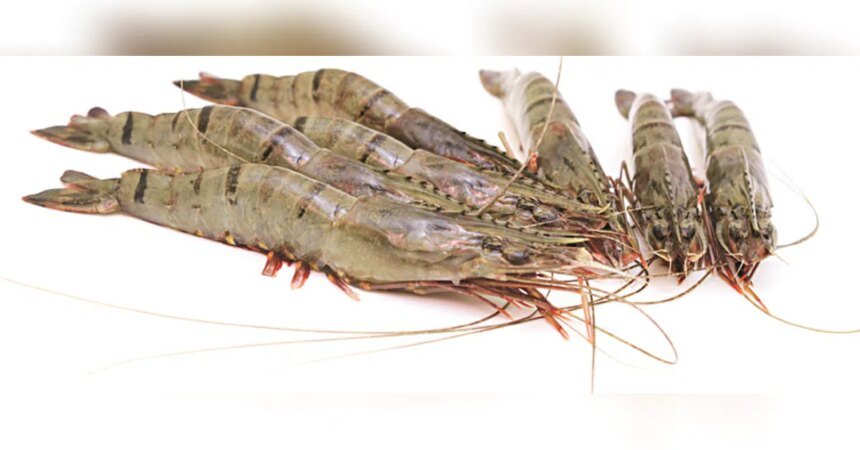
Now, after more than a decade in decline, the species has staged a remarkable recovery.
From a peak export value of $833 million on shipments of 76,480 tonnes in 2011-12, Black Tiger exports slumped to just $108.9 million and 10,317 tonnes by 2020-21. Many in the industry had effectively written off the species. Yet within five years, the indigenous shrimp has engineered a dramatic revival, with exports climbing to $568.31 million on volumes of 61,780 tonnes in 2025-26, the highest level in 13 years. That represents more than a fourfold increase in value from the FY21 trough. Supported by a weaker rupee, export earnings touched a record ₹4,974 crore in local currency terms.
Black tiger’s decline, meanwhile, paved the way for Vannamei shrimp, which emerged as the key revenue-generator for Indian seafood exporters. Introduced into India only in 2009 and exported commercially from 2011-12, Vannamei has seen export earnings surge from just $397.81 million in its debut year to $4.76 billion in 2025-26. The variety now accounts for more than 65 per cent of India’s marine export earnings.
“The crisis which Tiger shrimp went through in the 2010s was unparalleled. It was almost a washout for the variety because of that disease outbreak. We even faced import restrictions in countries like Japan and the United States. Now, Tiger has scripted a rare comeback in the marine industry to the half-a-billion-dollar mark,” P Jawahar, chairman of the Marine Products Export Development Authority (MPEDA), told Business Standard on the sidelines of the National Skill Olympiad on Seafood Value Addition in Chennai last week. “In the past one year alone, export value increased by 38 per cent to $568 million.”
Why black tiger lost its crown
India was long regarded as the natural home of black tiger shrimp. In 2010, the species accounted for nearly 80 per cent of the country’s shrimp exports and around 11 per cent of overall marine exports. But recurring outbreaks of WSSV from the late 1990s steadily pressured the sector.
Highly vulnerable to disease and stress, farming for black tiger shrimp increasingly relied on antibiotics as a preventive measure. Disease outbreaks also depressed farm productivity and returns. Japan was the first to impose 100 per cent inspection on Indian black tiger shipments after detecting the banned antibiotic furazolidone in farmed shrimp. Several other importing nations subsequently followed with similar restrictions.
“It was Vannamei that helped the Indian farmers sustain during this time, and they shifted to this variety,” Jawahar said. Vannamei offered multiple commercial advantages: Faster growth, higher survival rates, greater stocking density, superior feed conversion, higher productivity and, crucially, access to specific pathogen free (SPF) broodstock.
The turnaround began with an early government intervention. Recognising the risk of black tiger farming disappearing altogether, the Ministry of Commerce and Industry, through MPEDA, initiated revival measures back in 2014.
According to Jawahar, setting up a nucleus breeding centre in the Andaman and Nicobar Islands that year proved to be the inflection point. The facility focused on domesticating and selectively breeding black tiger shrimp, reducing dependence on disease-prone wild broodstock. The resulting broodstock was subsequently supplied to hatcheries as quality parent stock for seed production.
“This ensured that farmers got high-quality pathogen-free black tiger seed, improving survival rates and productivity. This was followed by training farmers in better management practices and antibiotic-free farming. All these helped black tiger’s return,” said Anil Kumar P, joint director (marketing) at MPEDA.
Industry sources attribute the revival to a combination of scientific intervention, tighter farm-level controls and sustained diplomatic engagement. Following a series of bilateral discussions, Japan lifted its import restrictions on Indian black tiger shrimp in December 2020.
According to Kumar, expanding into newer markets such as China and the European Union has reinforced the recovery of India’s premium indigenous shrimp. The European Union could emerge as the principal growth engine, particularly if the proposed India-EU free-trade agreement materialises. Ecuador, India’s principal competitor in the segment, currently enjoys the advantage of zero-duty access into the EU market.
“China and the EU are our major partners in shrimp exports now,” Kumar said.
India exported 1,972,018 tonnes of seafood worth ₹73,890.46 crore ($8.46 billion) during FY26, setting new records in both volume and value despite challenging global market conditions. Frozen shrimp remained the industry’s dominant export category, generating ₹49,037.93 crore ($5.62 billion). It accounted for 40.19 per cent of total seafood export volumes and 66.52 per cent of total export earnings in dollar terms.