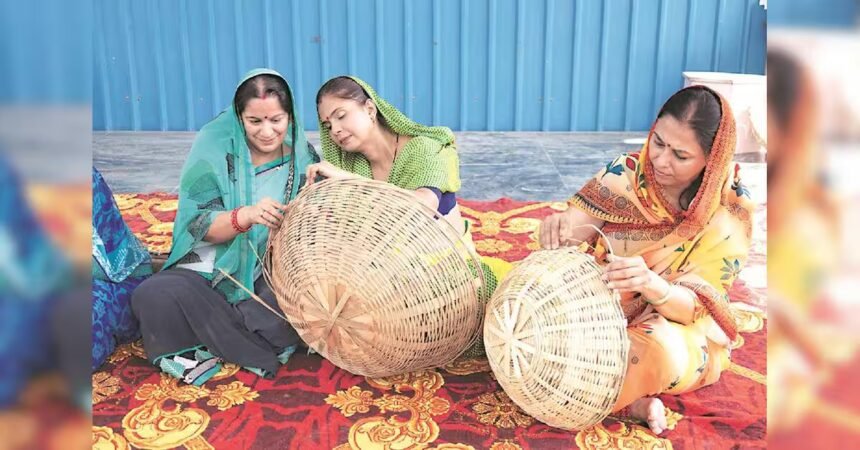
Rural women’s labour force participation rate nearly doubled from 24.6 per cent in 2017-18 to 47.6 per cent in 2023-24, one of the sharpest increases anywhere in the world, the study said.
However, the rise does not reflect a corresponding increase in women being hired. Instead, more women are being counted as “self-employed”, a category that includes everything from running a shop to working unpaid on a family farm.
According to the latest monthly bulletin of the Periodic Labour Force Survey (PLFS), released by the Ministry of Statistics on October 15, unemployment among rural women fell to 3.9 per cent, its lowest level this year.
The bulletin showed that rural women’s labour force participation rate stood at 38.9 per cent, the second highest since March 2026. The rate for urban women rose to 25.9 per cent, its highest in nearly a year. However, urban women faced greater difficulty finding work, with their unemployment rate at 9.2 per cent, more than double the rural rate.
The Oxfam analysis found that the share of rural women workers classified as self-employed rose from 57 per cent in 2017-18 to 72.2 per cent in 2023-24. Of these, 59 per cent were unpaid helpers in family enterprises.
Over the same period, the share of employed women in regular salaried jobs fell from 11 per cent to 8 per cent, while that in casual labour declined from 32 per cent to 20 per cent.
“In other words, as women have moved into work, they have moved out of the categories that typically come with a wage, a contract, or any security, and into unpaid or precarious own-account roles,” the analysis noted.
Much of this shift has been towards agriculture, the study said. The rise in female labour force participation, led by rural women, largely reflects economic distress, unpaid work and informal employment, with women returning to agriculture rather than moving into other sectors.
The share of women reporting domestic duties as their primary activity fell sharply, while the proportion working as unpaid helpers in household enterprises or as own-account workers rose. This points to a shift from unpaid domestic work to unpaid or poorly paid self-employment, rather than towards secure incomes, the study said.
The burden is particularly heavy on disadvantaged women. Uttar Pradesh accounts for about 17 per cent of India’s self-employed women, 91 per cent of whom work in agriculture. Most do not own land in their names, limiting their access to credit and markets.
The study also flagged policy changes as a concern. Women accounted for 54 per cent of person-days under the Mahatma Gandhi National Rural Employment Guarantee Act (MGNREGA), which has been replaced by the VB-GRAM-G Act.
“Unlike the old demand-driven guarantee, the new scheme rations work to specific seasons, shifts 40 per cent of the wage bill onto states — many of them fiscally stressed — and requires twice-daily geo-tagged photo uploads through a mobile app, a barrier for women with limited digital access and skill,” the study said.
The analysis argued that, while the increase in rural women’s participation in the workforce is real, describing it as employment risks obscuring the nature of the work. Millions of women have entered the workforce, but many have found agricultural work instead of paid jobs and unpaid family roles instead of wages. The poorest among them often work on land to which they have no legal claim.
What the Oxfam study found
- 47.6%: Rural women’s labour force participation nearly doubled from 24.6% since 2017-18
- 72.2%: Share of self-employed rural women rose from 57%; most are unpaid family workers
- 59%: Self-employed rural women work as unpaid helpers in family enterprises
- 8%: Fall in regular salaried jobs from 11%
- 20%: Drop in casual work dropped from 32%
- 91%: Self-employed women in Uttar Pradesh work in agriculture, often without land titles
- 54%: Women accounted for over half of MGNREGA person-days before the shift to VB-GRAM-G