Last Updated:
A source said the government’s focus right now is consolidating its numbers in Parliament after rebellion in parties like TMC and Shiv Sena (UBT)




The NDA government, which is close to securing a two-thirds majority, is preparing to push several key legislation during the session, including two constitutional amendment bills.
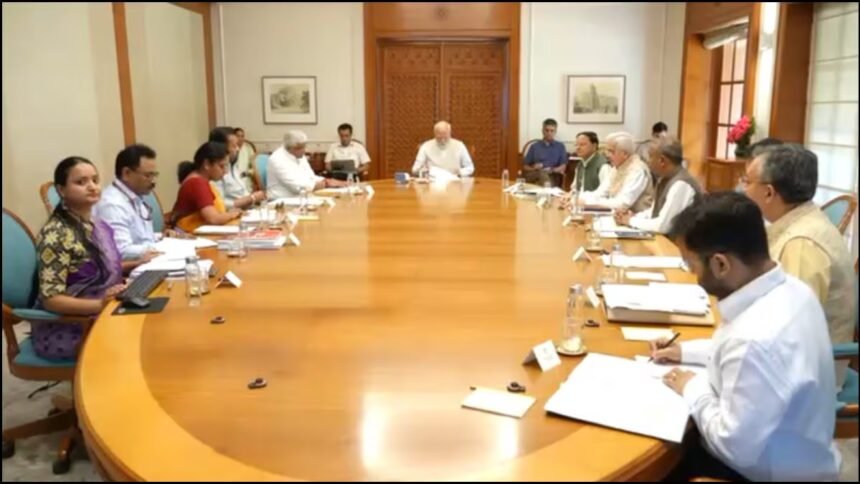
(Representational pic/News18)
A Cabinet reshuffle in the Narendra Modi government is unlikely till the end of the crucial monsoon session of Parliament in August, reliable sources have told CNN-News18. Any exercise, if undertaken, is expected only in the months after the session concludes.
“The Prime Minister usually sounds out some of his senior ministers 3-4 days in advance of a Cabinet reshuffle. Nothing of this sort has happened so far. The PM is leaving for a week-long foreign tour next week, and the Parliament session is expected to begin a week later (July 20). The government’s priority is the upcoming session of Parliament where some crucial legislation will come up,” a top source in the government told CNN-News18. There has been intense speculation over the Cabinet reshuffle as the Modi government recently completed two years in its third term in office.
Another reliable source said the government’s focus right now is consolidating its numbers in Parliament after the TMC rebel MPs and six of those from the Shiv Sena (UBT) have pledged support to it. The government needs a two-thirds majority to get certain constitutional amendment bills passed as it plans to bring the delimitation bill and the women’s reservation bill again in the monsoon session of Parliament. The source said the government’s hope is that the DMK could walk out at the time of voting, as it would not stand with the Congress any more in Parliament after being dumped by it in Tamil Nadu in favour of an alliance with the Vijay government.
“However, our numbers are still short in the Lok Sabha when it comes to the 2/3rd mark,” this source conceded.
CNN-News18 had earlier reported that the Parliament’s monsoon session is likely from July 20 to August 13, and a high-voltage political showdown is expected.
With political realignments in several regional parties and an aggressive opposition gearing up to corner the government, the session is expected to be highly contentious.
Ahead of the session, the Lok Sabha Speaker may take a call on the reported merger of 20 rebel TMC MPs and also six Shiv Sena (UBT) MPs with the Shiv Sena (Shinde faction). A decision is also likely on the seating arrangement of the rebel MPs in the Lok Sabha.
The NDA government, which is close to securing a two-thirds majority, is preparing to push several key legislation during the session, including two constitutional amendment bills.
The government is likely to reintroduce the 131st Constitutional Amendment Bill on women’s reservation and delimitation with proposed amendments. The revised bill may include a provision to increase the strength of the Lok Sabha and state legislative assemblies by 50%.
The 130th Constitutional Amendment Bill may propose that the prime minister, chief ministers, and ministers vacate office if they remain in jail for more than 30 days. A Joint Parliamentary Committee is expected to recommend safeguards to prevent misuse of the provision.
The government is also likely to move forward with the extension given to the committee for the One Nation, One Election Bill. The contentious legislation relating to FCRA are also likely to come in the upcoming session. Other bills, Viksit Bharat Shiksha Adhishthan, anti-doping reforms, increasing the number of Supreme Court judges, corporate law reforms, and the Securities Market Code could be brought for passage.
The opposition is preparing to target the government over the deficient monsoon, drought and floods, the NEET paper leak, the alleged theft of offerings at the Ram Temple, rising petrol and diesel prices, inflation, and unemployment.
It is also expected to raise issues related to the Special Intensive Revision (SIR) of electoral rolls and the government’s alleged role in splits within regional parties.
About the Author

Aman Sharma, Executive Editor – National Affairs at CNN-News18, and Bureau Chief at News18 in Delhi, has over two decades of experience in covering the wide spectrum of politics and the Prime Minister…Read More
Read More