Last Updated:
The three bills aim to clear the mandatory two-thirds parliamentary hurdle next week and set the stage for constituency redrawing ahead of the 2029 polls




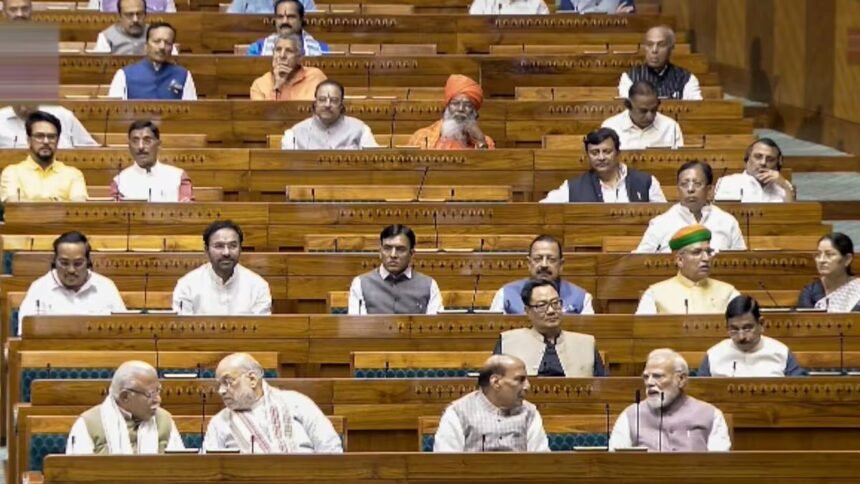
To guarantee that no state loses relative political weightage, the bill retains the 1971 Census as the baseline for inter-state seat allocation and mandates a uniform 50 per cent increase in Lok Sabha seats across every state and Union Territory during the first delimitation exercise after the amendment takes effect. File image: PTI
In a decisive move to break the legislative deadlock over delimitation and 33 per cent women’s reservation, the Union government has circulated a three-bill legislative package to MPs ahead of Parliament’s reconvened sitting on Monday, November 30. Anchored by the Constitution (132nd Amendment) Bill, 2026, the draft legislation gives a written constitutional guarantee that every state’s proportional representation in the Lok Sabha will remain intact through a uniform 50 per cent seat expansion, while freezing inter-state seat readjustments until 2051.
The draft bills were circulated on Friday evening, hours after Tamil Nadu Chief Minister and DMK president MK Stalin reiterated on social media that any reduction in Tamil Nadu’s existing 7.18 per cent share of Lok Sabha seats would be unacceptable, and demanded that the 1971 Census-based distribution among states remain frozen for another 25 years. By writing both safeguards directly into the constitutional text, the Centre has moved to address the core objection that sank its earlier Constitution (131st Amendment) Bill in April 2026.
Inside the Constitution (132nd Amendment) Bill, 2026
Unlike the earlier April draft, which relied on verbal assurances without codifying proportional protection, the newly circulated Constitution (132nd Amendment) Bill, 2026 amends Article 81 of the Constitution to raise the Lok Sabha’s maximum constitutional strength from 550 to 850—comprising up to 815 seats from states (up from the current cap of 530) and 35 seats from Union Territories (up from 20).
To guarantee that no state loses relative political weightage, the bill retains the 1971 Census as the baseline for inter-state seat allocation and mandates a uniform 50 per cent increase in Lok Sabha seats across every state and Union Territory during the first delimitation exercise after the amendment takes effect. Crucially, the bill freezes inter-state delimitation until 2051—substituting the existing constitutional reference to “the first census taken after the year 2026″ with “until the year 2051″.
At the same time, by amending Article 82, the government proposes using 2011 Census figures—rather than waiting for a post-2026 Census—to redraw internal constituency boundaries within each state and Union Territory. The bill also amends Article 170 to raise the maximum ceiling on state legislative assemblies from 500 to 650 seats, paving the way for larger states such as Uttar Pradesh—currently capped at 500—to see an expansion of around 150 seats alongside a uniform 50 per cent assembly hike across states.
How the Delimitation Bill and UT Laws Amendment Complete the Package
At A Glance
The Union government circulated a three-bill legislative package including the Constitution (132nd Amendment) Bill, 2026 to MPs.
The draft legislation proposes raising the Lok Sabha’s maximum constitutional strength from 550 to 850 seats.
Inter-state seat readjustments are frozen until the year 2051 using the 1971 Census as the baseline.
The Delimitation Bill provides the statutory framework to implement a one-third reservation for women in the Lok Sabha and state assemblies ahead of the 2029 general elections.
Alongside the Constitution (132nd Amendment) Bill, the government is introducing two companion legislations on Monday to operationalise the expansion and women’s quota ahead of the 2029 general elections.
The second legislation, the Delimitation Bill, provides the statutory framework to give immediate effect to one-third reservation for women—including women from Scheduled Castes and Scheduled Tribes—in the Lok Sabha and state and Union Territory legislative assemblies. It empowers a Delimitation Commission to readjust the allocation of seats and divide each state and Union Territory into newly drawn territorial constituencies, ensuring that women’s reservation is rolled out without reducing the existing pool of unreserved seats.
The third piece of legislation, the Union Territories Laws (Amendment) Bill, updates statutes governing Union Territories so that the 50 per cent seat expansion, boundary redrawing, and 33 per cent women’s reservation apply uniformly across Union Territories with legislatures. Together, the three bills aim to clear the mandatory two-thirds parliamentary hurdle next week and set the stage for constituency redrawing ahead of the 2029 polls.
Quick Answers
 Ask News18
The Constitution (132nd Amendment) Bill, 2026 amends Article 81 to raise the Lok Sabha’s maximum strength from 550 to 850 seats. It guarantees a uniform 50 per cent seat expansion across every state and Union Territory while freezing inter-state seat readjustments until 2051.
Ask News18About the Author

Arunima is Editor (Home Affairs) and covers strategic, security and political affairs. From the Ukraine-Russia War to the India-China stand-off in Ladakh to India-Pak clashes, she has reported from gr…Read More
November 27, 2026, 22:35 IST
Read More