Last Updated:
Priyanka made the remark while questioning the composition of the government’s newly constituted task force to reform India’s examination system




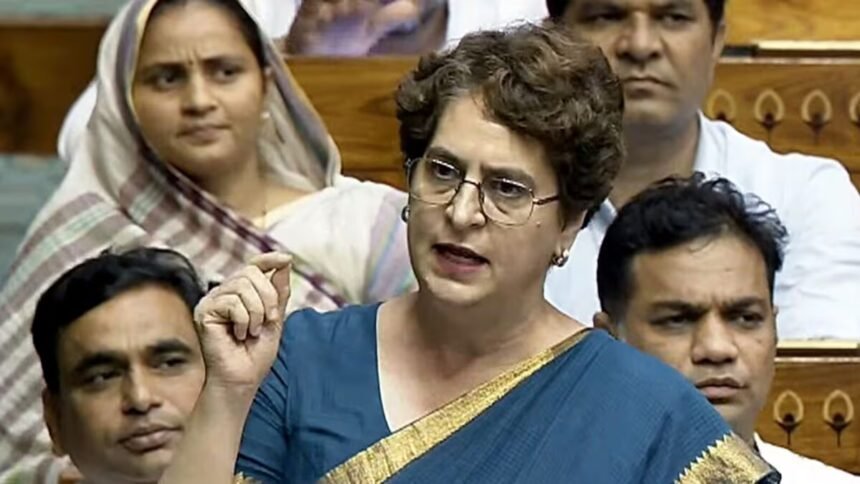
Priyanka Gandhi Vadra’s remarks triggered strong reactions from BJP members in the Lok Sabha. File image/ANI
The Congress and the BJP have once again found themselves locked in an ideological battle, but this time the flashpoint is not Hindutva, reservations, or elections. Instead, it is a remark directed at one of India’s most accomplished scientists.
An open letter signed by senior academics, including 215 vice-chancellors, has criticised Congress MP Priyanka Gandhi Vadra for ostensibly referring to IIT Madras Director Prof V Kamakoti as a “gaumutra expert“, arguing that such language undermines scientific discourse rather than challenging scientific claims.
“Professor Kamakoti is the head of one of India’s foremost scientific and technological institutions. He has M.S. and PhD degrees in Computer Science and Engineering from IIT Madras. He has published over 150 research papers and has been involved in over 50 R&D projects. He has several honours and accolades to his name, including the DRDO Academic Excellence Award and the Indian Electronics and Semiconductor Association Techno Visionary Award. He has been the guiding force behind India’s first industry-grade microprocessor. Needless to say, he is one of the top tech brains of the country,” reads the open letter.
Priyanka made the remark while questioning the composition of the government’s newly constituted task force to reform India’s examination system. “The Radhakrishna Committee was also formed to bring in reforms. Till date, none of its recommendations have been implemented,” she said in Parliament. “And now this new committee has an ex-IB chief, an owner of an IT company, and also a ‘gaumutra visheshgya‘ (cow urine expert). What do they know about education?”
The letter deliberately shifts the debate away from cow urine or traditional medicine and towards a larger constitutional question: whether politicians should attack scholars personally instead of engaging with their arguments. It invokes the constitutional duty to develop scientific temper, arguing that scientific inquiry requires objective examination of claims rather than ridicule.
The intervention is politically significant because Prof Kamakoti is not merely another academic. As Director of IIT Madras, with more than 150 research publications and a central role in developing India’s first industry-grade microprocessor, he occupies one of the most respected positions in India’s scientific establishment. The signatories argue that disagreement with his views should come through evidence and debate, not dismissive labels. For the BJP, the controversy presents an opportunity to reinforce a familiar political narrative—that the Congress continues to look down upon Indian knowledge traditions and sections of the scientific community willing to engage with them. The party has frequently accused its opponents of ridiculing cultural practices rather than debating them on scientific grounds.
For the Congress, however, the episode carries a different risk. While the party has consistently projected itself as a defender of scientific temper and constitutional values, critics may argue that personal attacks weaken that very claim. The open letter contends that Parliament should remain a forum where ideas are contested through evidence, not caricature. The timing is also notable. India is investing heavily in semiconductors, artificial intelligence, and advanced manufacturing, making scientists and research institutions increasingly central to national policy. Political attacks on leading academics, therefore, resonate beyond partisan politics, touching upon the relationship between science, governance, and public trust.
The authors, including former Vice-Chancellor of ICT Mumbai Prof GD Yadav and Secretary General of Association of Indian Universities Prof Pankaj Mittal, leave little doubt about where they stand. They argue that democracy thrives on disagreement, but that mockery cannot substitute reasoned engagement, particularly when it comes to scientific questions.
Whether the political class embraces that distinction may determine whether the debate evolves into a substantive discussion on science and evidence—or remains another partisan slugfest.
Hitting out at Priyanka, the scholars write, “Equally troubling is the message such remarks send to India’s academic and research community. Our scientists, scholars and educators deserve to know that they can participate in public debate without fear of being reduced to dismissive labels. Criticise their arguments, challenge their evidence, demand higher standards of proof, but do not diminish scholarship itself.”
With so many academicians up in arms, the Congress at the moment seems to be on the back foot on the issue.
About the Author

Anindya Banerjee, Associate Editor brings over fifteen years of journalistic courage to the forefront. With a keen focus on politics and policy, Anindya has garnered a wealth of experience, with deep …Read More
Read More