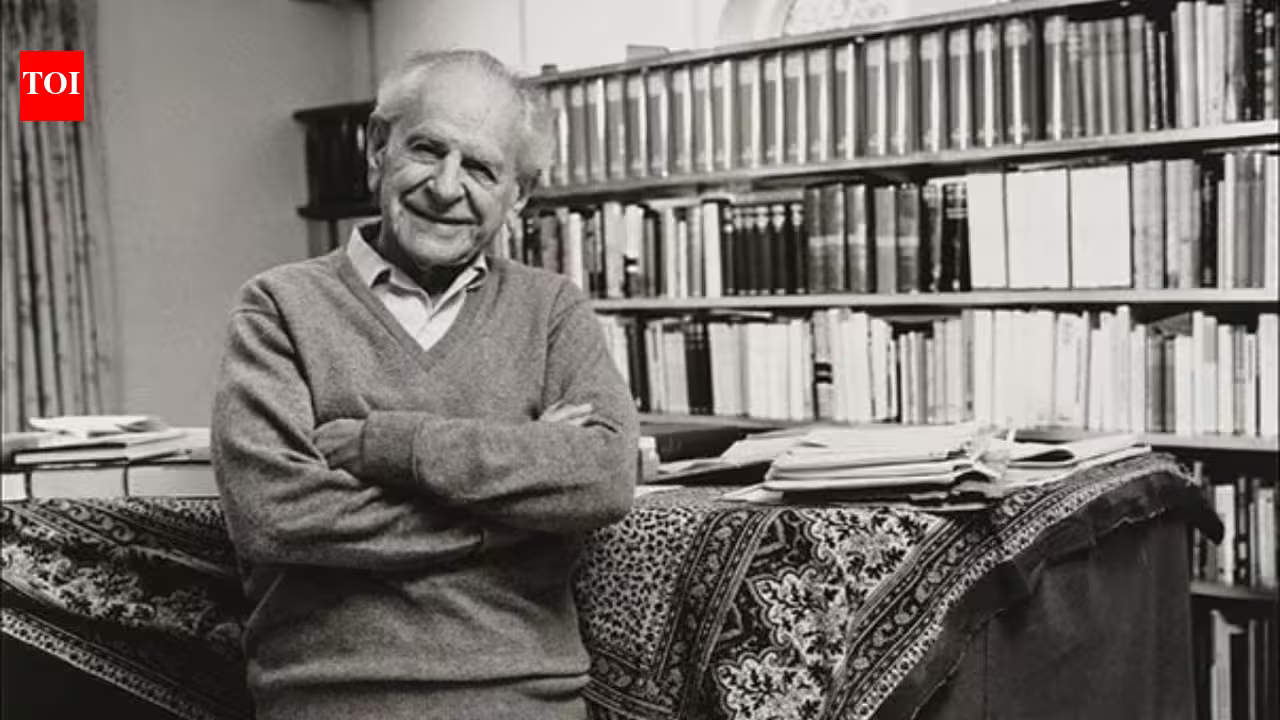
In 1919, a seventeen-year-old student in Vienna joined a street demonstration organized by young communists. Police opened fire on the unarmed crowd, killing twelve people and wounding dozens more. The young student had encouraged his friends to march because he believed that short-term violence was a necessary step toward an inevitable social utopia. Standing in the blood-stained street that afternoon, he experienced a complete collapse of faith. He realized that an ideology promising absolute perfection had pushed aside his moral judgment and led directly to human sacrifice.That student was Karl Popper, and the lesson of that afternoon stayed with him for the rest of his life. Decades later, he summed up his warning in a single observation: “Those who promise us paradise on earth never produced anything but a hell.”The quote cuts through political salesmanship and points to a repeated tragedy in human history. When leaders claim they have the perfect plan for creating a flawless society, they often demand great power to put that plan into action. Because perfection is impossible in a complex world, reality eventually resists the plan. Instead of admitting that their theory has failed, utopian leaders blame human weakness. They label critics as enemies of paradise who must be silenced, re-educated, or eliminated.The promise of earthly perfection can become a moral blank cheque, allowing immediate cruelty to be justified in the name of future happiness.
Writing in exile while Europe burned
Karl Popper published this observation in his 1945 masterwork, The Open Society and Its Enemies.Born in Vienna in 1902 to a Jewish family that had converted to Lutheranism, Popper left Austria in 1937 as fascism spread across Central Europe. He accepted a lectureship in philosophy at Canterbury University College in Christchurch, New Zealand, where he lived in relative isolation during the Second World War.Popper described The Open Society and Its Enemies as his personal contribution to the war effort. He wrote the two-volume work in his small office in Christchurch between 1938 and 1943. The book tried to identify the intellectual roots of totalitarianism while Allied forces were fighting Axis armies across Europe and Asia.In Chapter 18 of the second volume, Popper directly criticized utopian social engineering. He compared it with what he called “piecemeal social engineering.”His main target was a philosophical tradition stretching from Plato through Georg Wilhelm Friedrich Hegel to Karl Marx. Popper argued that these thinkers had fallen into what he called “historicism”, the mistaken belief that history follows fixed laws toward a predetermined destination.When political leaders accept historicist thinking, they can begin to see human lives as expendable parts of some final social structure.
The psychology of utopian tyranny
Popper’s criticism rests on a basic idea about knowledge: human beings are naturally fallible.In his philosophy of science, Popper argued that no amount of observation can prove a theory completely correct, but one clear counter-example can show that it is false. He believed political theories should be treated in a similar way and should remain open to testing and criticism.Utopian schemes break this rule because they treat their final goal as obvious and unquestionable. If a political blueprint cannot be challenged, it cannot be corrected when it fails.A piecemeal reformer introduces a small policy change, such as adjusting a tax rate or building a local clinic. The results can then be measured. If the policy fails, it can be changed or removed without destroying the whole society.A utopian planner works in the opposite way. Because the goal is total transformation, failure is often blamed on enemies, institutional resistance, or a lack of commitment.The French Revolution’s Reign of Terror in 1793 offers a clear historical example. Maximilien Robespierre wanted to create a “Republic of Virtue” based on the political ideas of Jean-Jacques Rousseau. To create perfect virtue, Robespierre came to believe that terror was necessary. Thousands were sent to the guillotine to defend an ideal that existed mainly in his mind.Similar patterns appeared in the 20th century, from Stalin’s forced collectivization during the Five-Year Plans to the Khmer Rouge’s attempt to create an agrarian socialist state in Cambodia, where an estimated two million people died between 1975 and 1979.
Messy improvements over total overhauls
Popper’s warning remains relevant to modern institutions, public policy, and technology.In corporate management and Silicon Valley companies, founders often use grand mission statements about changing society or creating friction-free economies. When platform algorithms designed to increase user engagement end up spreading political extremism or harming young people’s mental health, executives may continue defending the larger vision instead of dealing with the immediate damage.The technology industry’s desire for total disruption can resemble the utopian mindset Popper warned about: putting an imagined future ahead of people’s needs and wellbeing today.In government, the quote offers a useful way to judge political promises. Candidates who promise complete overhauls of complicated systems, whether healthcare, energy, or international trade, can underestimate the unexpected effects of rapid, top-down change.Good leadership requires accepting that society is too complicated for one person or one authority to control through a grand design.In a 1989 interview published in Le Monde, Popper again argued that political action should focus on reducing real suffering rather than trying to create perfect happiness.“Work for the elimination of concrete evils rather than for the realization of abstract goods,” Popper insisted. “Do not aim at establishing happiness by political means. Rather aim at the elimination of concrete miseries.”By rejecting promises of total perfection, open societies protect people’s right to criticize their leaders, correct mistakes through peaceful elections, and make small, measurable improvements without destroying the whole system to fix a problem.