

India’s jewellery market is facing a gold paradox: consumers are buying fewer grams, but jewellery spending remains resilient. Record gold prices are weighing on volumes, yet organised jewellers are growing by selling lighter products, diamonds, newer designs and, increasingly, a broader brand proposition.
Titan’s jewellery business grew 43% in the June quarter, while Kalyan Jewellers reported 46% growth in consolidated revenue. Senco Gold also entered FY27 with strong growth. At the same time, the World Gold Council (WGC) said India’s jewellery demand fell 17.1% by volume in H1 2026.
The divergence is forcing a rethink of how India’s roughly ₹7 lakh crore jewellery market is growing: it is no longer about selling more grams of gold, but about selling more value per gram.
“While the overall volume demand for jewellery could remain under pressure owing to the steep rise in gold prices and price-sensitive nature of purchases, the overall consumer spending on jewellery is expected to remain resilient,” said Akhil Goyal, director, CareEdge Ratings.
Fewer grams, bigger bills
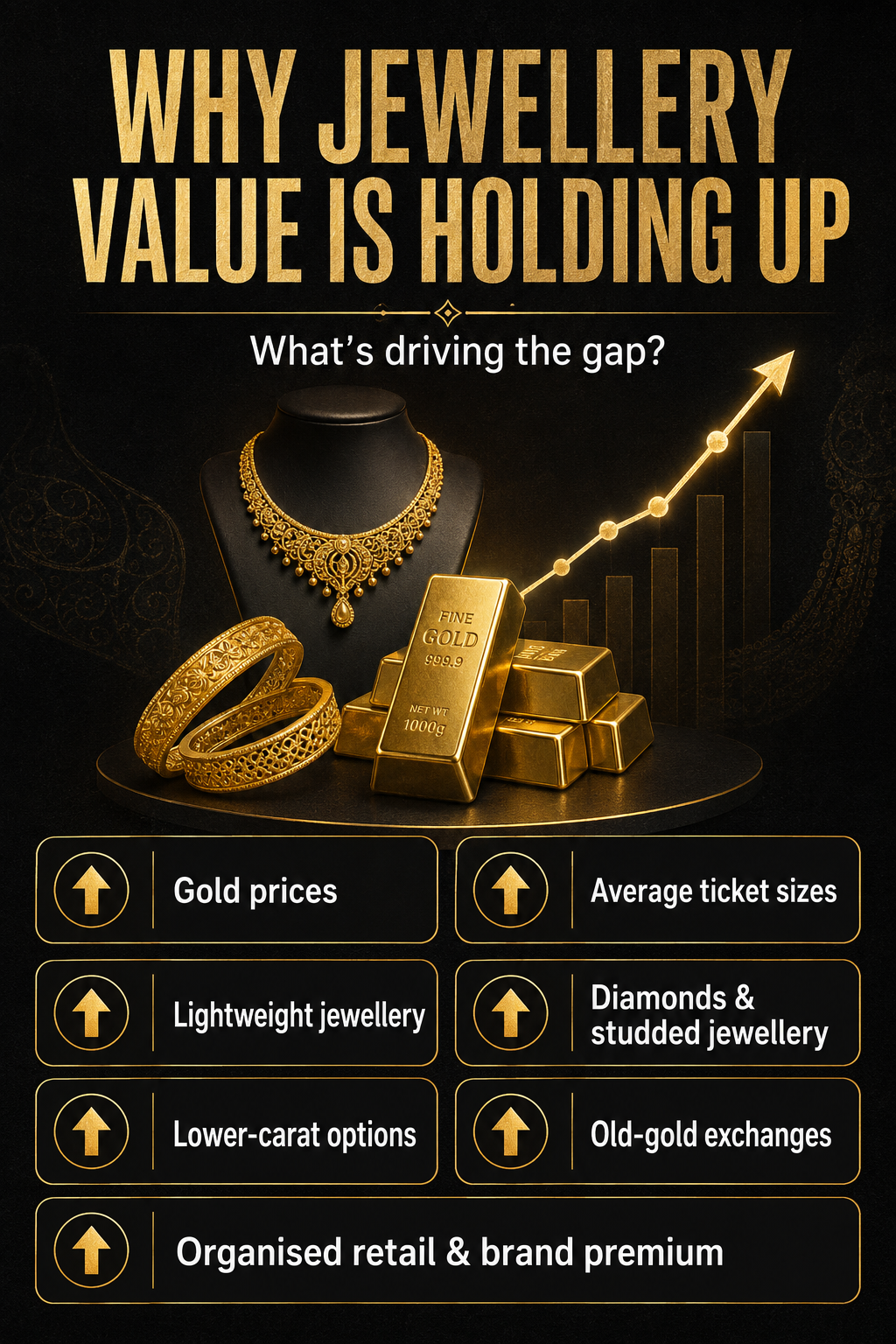
The WGC’s India Focus report for Q2 CY2026 captured the shift. Higher gold prices pushed consumers towards “lighter-weight, lower-carat, and studded jewellery”, while exchange-led purchases also gained traction across retailers.
In Q2 CY2026, India’s jewellery demand fell 15.4% year-on-year to 75.1 tonnes, while jewellery demand value rose 34.4% to ₹1.13 lakh crore, according to the WGC. In H1 2026, jewellery volumes fell 17.1%, while demand value rose 40% to ₹2.13 lakh crore.
The divergence helps explain how jewellers can continue reporting revenue growth even when gold volumes weaken.
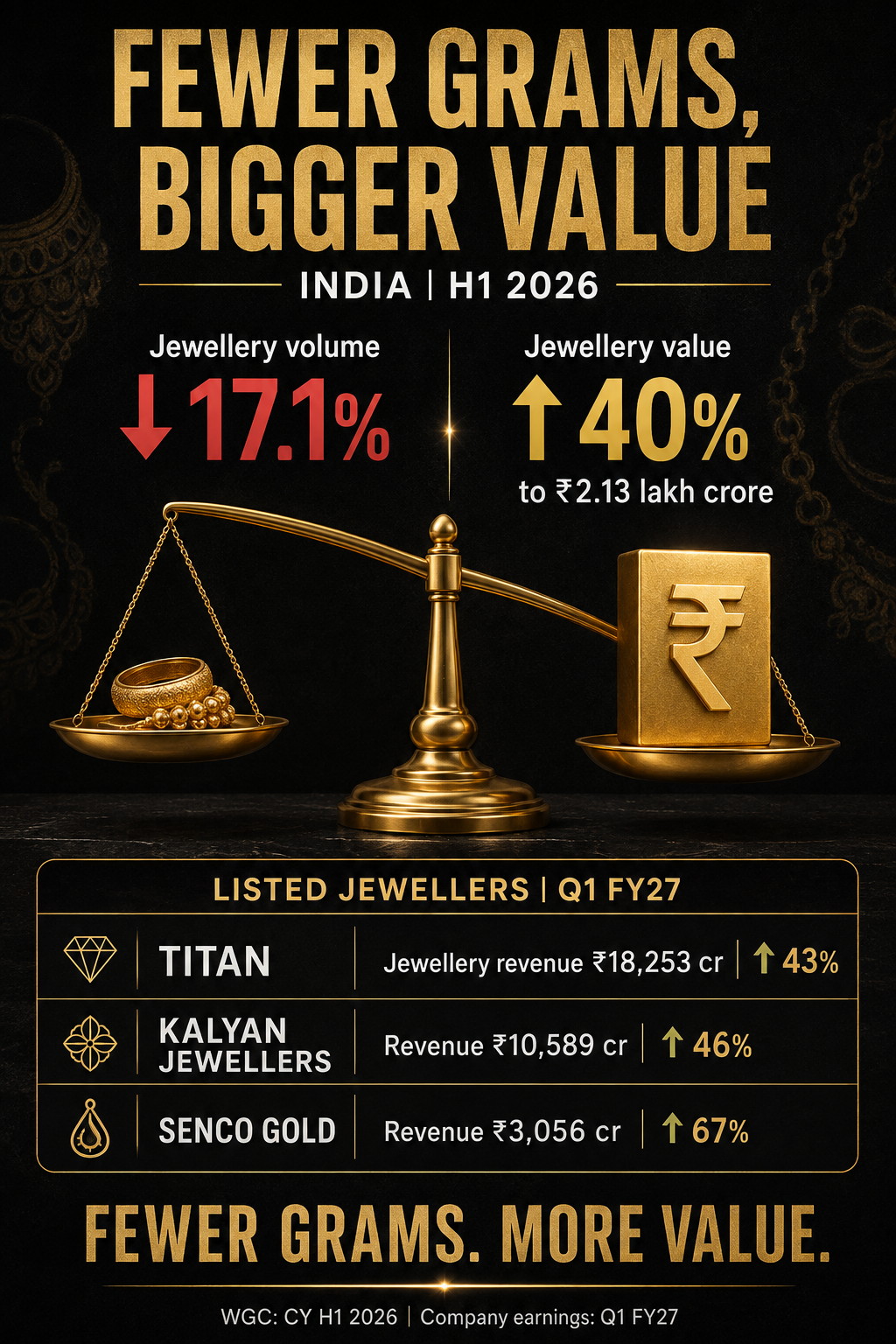
Titan showed a similar trend in Q1 FY27. Its jewellery business grew 43%, with buyer growth in the early double digits and average ticket sizes rising in the high double digits. Plain and studded jewellery each grew in the mid-thirties.
The company added 33 jewellery stores during the quarter, taking its jewellery network to 1,227 outlets. Tanishq, Mia, Zoya and beYon together grew 39%, while CaratLane grew 42%.
Old gold is becoming a growth engine
Kalyan Jewellers offers another clue to how retailers are navigating expensive bullion.The company’s consolidated revenue rose 46% to ₹10,589 crore in Q1 FY27. Separately, recycled gold accounted for more than 46% of revenue during the quarter.
Its “Shine with India” gold recirculation campaign, launched in May, pushed recycled gold’s share of revenue above 55% in June, with the company aiming to maintain the share at 55%-60%.
The strategy was aimed at reducing dependence on imported gold. “The larger objective of the initiative was to increase the share of recycled gold, reducing the dependence on imported gold, thereby make the business more resilient,” said Ramesh Kalyanaraman, executive director, Kalyan Jewellers, during the company’s Q1 FY27 earnings call.
Recycling allows retailers to turn gold already held by Indian households into new jewellery instead of relying on the same amount of freshly imported bullion.
A May 2026 report by CBRE, All That Glitters: Jewellery Brands Recast India’s Retail Footprint, describes a move towards “organised retail, branded formats, and experience-driven environments”. Jewellery’s share of organised retail leasing increased from 2% in 2019 to 8% in 2025.
The size of stores is changing too. Showrooms larger than 8,000 sq ft accounted for 50% of jewellery retail leasing in 2025, up from 14% in 2019. The shift reflects the move from conventional jewellery shops to large-format experience centres.
CBRE identified organised retail, experience over investment, lab-grown diamonds and the rise of fashion jewellery as key forces reshaping the category.
Branding is no longer just advertising
Jewellers are putting more weight on brand building as they try to broaden what they sell.
Senco Gold’s management said in its May 2026 earnings call that “there’s a balance between the brand building, serving the customer and still taking the market share.”
That strategy is visible in its Q1 FY27 numbers. Diamond jewellery value grew 43% year-on-year and volumes 18%, while the company said consumers were moving towards lightweight, design-led everyday wear.
Senco is prioritising 9-carat and 14-carat lightweight collections and has introduced a titanium jewellery range for men priced at ₹20,000-₹1 lakh. The company also said it introduces about 1.5 lakh new designs a year. “Small-ticket items are also selling. Items priced at Rs 40,000-50,000 are selling, as are Rs 1 lakh and Rs 5 lakh pieces. But the larger share is coming from the mid-range segment,” Senco Gold told ET Online earlier this month.
Gold gets its glitter back as Indian buyers return ahead of wedding and festive season
India’s gold demand is recovering after June’s price correction, with jewellery purchases, imports and retailer stocking picking up ahead of the festive season. Gold ETFs also continue to attract investors, while old-gold exchanges are helping consumers manage elevated prices.
Senco is also using Sennes to move beyond traditional gold jewellery. The lifestyle brand spans lab-grown diamond jewellery, leather accessories and fragrances, and the company added a Sennes showroom in Q1 FY27. The brand had turned EBITDA-positive in its second year, according to Senco’s Q4 FY26 earnings commentary.
The shift is broader than gold jewellery alone. Jewellers are expanding their product ranges and formats as consumers buy across categories and price points.
Younger buyers want something different
CareEdge’s 2026 industry research says consumers are becoming more receptive to branded jewellery, particularly in metros and Tier-I cities, where rising media exposure and Western influences are increasing willingness to pay a premium. It also points to design innovation, certification and customer experience as increasingly important competitive factors.
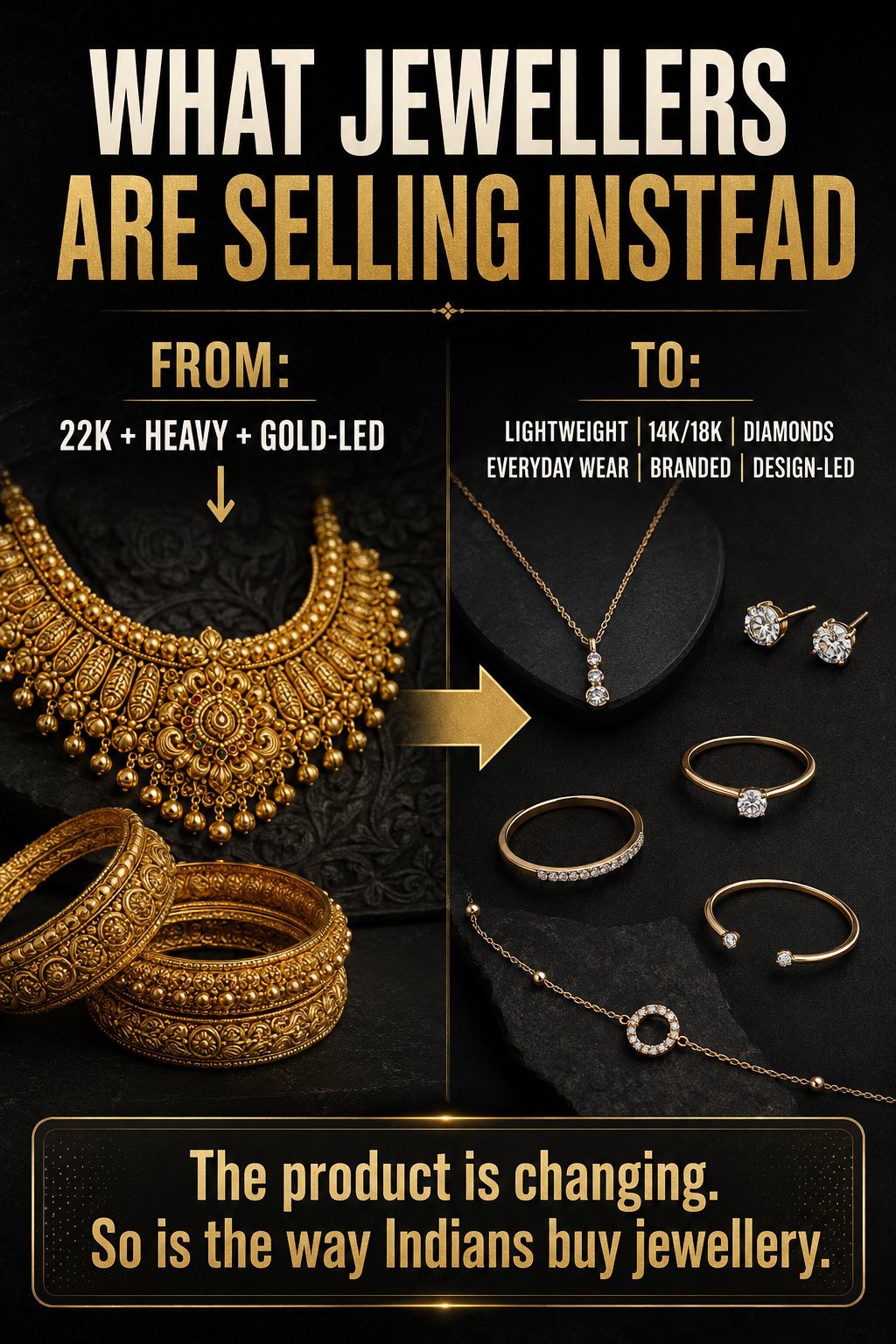
The research notes a shift from traditional heavy jewellery towards lightweight, trendy and customised pieces, with younger consumers showing interest in alternatives such as lab-grown diamonds.
“The young consumer is more demanding in terms of the variety and designing of products,” said Akhil Goyal, director, CareEdge Ratings.
CBRE’s 2026 research makes a similar point, describing lab-grown diamonds as an accessible luxury for younger consumers and fashion jewellery as a higher-frequency lifestyle category.
The shift is also widening jewellery’s role beyond a traditional investment or heirloom purchase, with CBRE highlighting fashion jewellery as a “versatile, high-frequency lifestyle accessory” and lab-grown diamonds as an accessible luxury for younger consumers.
Another way jewellers are responding to high gold prices is by widening the purity and product mix. Consumers now have more options across 9K, 14K, 18K and 22K gold, while diamonds and other stones are increasingly being paired with lower-purity gold to create products at more accessible price points.
For some buyers, a lighter 14K or 18K piece with diamonds can cost less than, or be comparable to, a heavier 22K gold design, depending on the weight, stone quality, design and making charges. This gives jewellers another way to offer design-led products without putting the entire price burden on gold content.
From gold retailer to lifestyle brand
Deloitte’s January 2026 industry report argues that the traditional jewellery retail playbook, built around rising inventory value and generational loyalty, is no longer sufficient for the corporate retailer of the future. Its operating framework covers merchandising, sourcing and supply chain, retail operations, finance and marketing, including consultative selling, exchange management and customer segmentation.
Titan has multiple brands serving different occasions and price points. Kalyan is expanding Candere while building regional propositions. Senco is investing in Sennes, lightweight jewellery and lower-carat products.

Indian jewellers may earn up to 1% incentive under revamped Gold Monetisation Scheme: IBJA
Indian jewellers could earn an additional 0.75%-1% commission under a revamped Gold Monetisation Scheme (GMS) proposed by the India Bullion and Jewellers Association (IBJA). Under the proposal, jewellers would collect customers’ old gold, pass it to refiners and receive a direct incentive, encouraging them to actively promote the scheme.
Organised retailers are trying to replace the traditional local jeweller’s biggest advantage — personal trust — with something that can travel across cities: a recognised brand, standardised purity, transparent pricing, exchange policies, digital discovery and a predictable store experience.
“Organised players have increasingly replaced relationship-based trust with brand-based trust,” Goyal said.
That shift is important because jewellery remains a high-value purchase where purity, authenticity, certification and buyback policies can influence where consumers shop.
Formalisation gives brands another tailwind
The opportunity becomes bigger because India’s jewellery market remains fragmented. Organised retail is gaining ground as consumers increasingly seek branded products, quality assurance and standardised buying experiences. A 2026 CareEdge industry report cited in filings with the Securities and Exchange Board of India (SEBI) expects the expansion of organised retail and omnichannel distribution to support growth in India’s gold and diamond jewellery market.
GST, mandatory hallmarking and PAN disclosure requirements have also reduced some of the advantages historically enjoyed by unorganised jewellers, according to CareEdge.
Organised chains are using that formalisation trend to expand into smaller cities while investing in regional brands, digital platforms and new formats.
The shift is therefore happening on two fronts: consumers are changing what they buy; retailers are changing how they sell it.
Higher gold prices may have accelerated both.