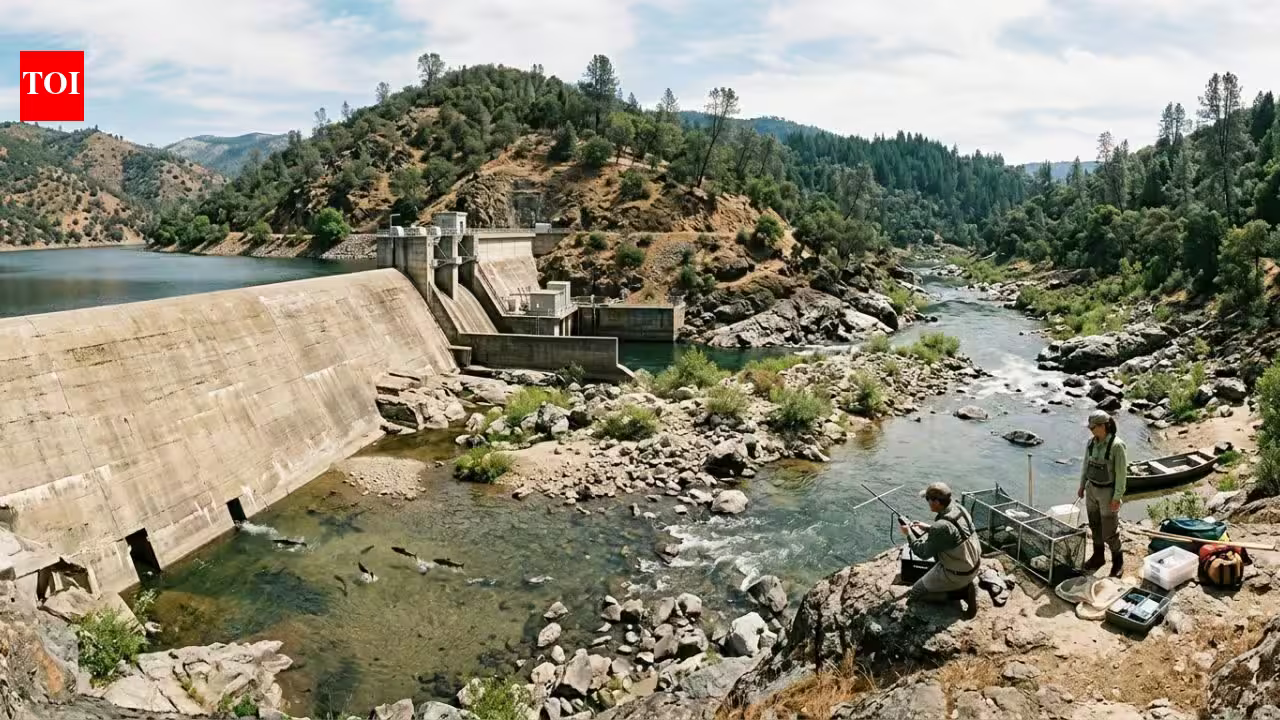
For much of its history, the San Joaquin River carried cold mountain water through California’s Central Valley, supporting forests, farms and some of the southernmost populations of Chinook salmon in the western United States. That connection began to disappear after the construction of Friant Dam in the 1940s, when large sections of the river were altered to supply irrigation water. Decades later, a major restoration effort is attempting to repair that break. The San Joaquin River Restoration Program is reshaping parts of the river while working to return a lost salmon population and balance the needs of communities that depend on its water.
How the 1942 construction of Friant Dam transformed the San Joaquin River
The San Joaquin River once played an important role in the life cycle of Chinook salmon. Before large-scale water development transformed the landscape, salmon travelled upstream through the river system, including areas near the foothills of the Sierra Nevada. Spring-run Chinook were particularly dependent on the river’s cooler waters, spending months waiting in suitable habitats before beginning their journey back downstream.According to NOAA, that pattern changed after Friant Dam was completed in 1942 near the eastern edge of the Central Valley. The dam created Millerton Lake and redirected much of the river’s flow through canals used for agriculture. Over time, sections of the San Joaquin River below the dam became much drier, leaving salmon with fewer places to survive and reproduce.The spring-run Chinook population that once occupied the upper San Joaquin River eventually disappeared. While some tributaries of the lower river continued to support other salmon runs, the main river channel no longer provided the conditions needed for spring-run fish.The loss was not immediate. It happened gradually as water movement, temperature patterns and habitat availability changed over many years.
The 1988 lawsuit that paved the way for river restoration
The effort to restore the San Joaquin River began with a legal dispute that lasted nearly two decades.According to the National Oceanic and Atmospheric Administration (NOAA), in 1988, after the Bureau of Reclamation extended water contracts for farms and irrigation districts supplied by Friant Dam, the Natural Resources Defense Council and other groups filed a lawsuit against the federal government and Friant water users.The case argued that the operation of the dam did not meet California’s requirement that enough water should remain in rivers to protect fish populations. The legal challenge focused on a state law requiring dam operators to maintain sufficient flows for fish living below those structures.The lawsuit continued for years before a settlement was reached until September 13, 2006, NOAA reported. The agreement brought together environmental groups, agricultural water users and federal agencies. It created the foundation for what later became the San Joaquin River Restoration Program.Reportedly, Congress passed the San Joaquin River Restoration Settlement Act in March 2009, formally setting out the programme’s goals: restore fish populations in the river while limiting harmful effects on water supplies for farmers and irrigation contractors who rely on the system.
A river restoration project with two competing priorities
The restoration programme covers the stretch of river between Friant Dam and the point where the San Joaquin meets the Merced River.Its work is built around two objectives that sometimes require careful balancing. The first is ecological: bringing back a naturally reproducing population of spring-run Chinook salmon and improving conditions for other native fish species.The second involves water management. Restoring river flows means releasing water into areas that had previously received little or no regular flow. The programme aims to do this without creating unacceptable impacts for agricultural water users connected to the Friant Division.The challenge is finding a way for the river to function as an ecosystem again while recognising that the surrounding region has depended on its water infrastructure for generations.
The agencies working together
The San Joaquin River Restoration Program is not managed by a single organisation. Five state and federal agencies share responsibility for carrying out the settlement agreement.The Bureau of Reclamation leads many of the programme’s water management and restoration activities. The US Fish and Wildlife Service, NOAA Fisheries, California Department of Water Resources and California Department of Fish and Wildlife also contribute through scientific research, habitat planning, monitoring and technical support.Each agency brings a different role. Some focus on river operations and water movement, while others provide expertise on wildlife protection, fisheries management and long-term monitoring.The collaboration reflects the scale of the project. Restoring a river that has been heavily modified for decades requires decisions involving engineering, biology, agriculture and environmental regulation.
Bringing spring-run Chinook salmon back
The return of spring-run Chinook salmon has been one of the most visible parts of the restoration effort.In 2013, NOAA Fisheries approved the release of Central Valley spring-run Chinook salmon into the San Joaquin River under a special classification of the Endangered Species Act. The designation allowed the fish to be introduced outside their existing range while recognising that the population would be monitored as an experimental group.The classification also provided certain protections for landowners and water users within the restoration area. Activities that were otherwise lawful, such as normal land and water management practices, would not create the same level of legal risk associated with harming protected species.The first adult spring-run Chinook salmon returned to the San Joaquin River after more than six decades of absence, marking an important milestone for the programme. The return of individual fish, however, is only one part of the larger goal. The long-term aim is to establish a population that can survive and reproduce without constant human assistance.
Science behind the salmon recovery effort
Restoring salmon requires more than releasing fish into the river. Scientists need to understand where the fish can survive, how water temperatures affect them and what barriers prevent successful migration.The programme uses research plans and fisheries strategies to guide decisions about habitat improvements, hatchery practices and population monitoring. A fisheries framework developed for the restoration effort sets out targets for both spring-run and fall-run Chinook salmon. It examines problems affecting fish survival, including habitat limitations and environmental pressures within the river.The restoration team also uses tagged fish to study movement patterns. Juvenile salmon equipped with acoustic tracking devices have helped scientists understand how young fish travel through restored sections of the river and what challenges they face along the way.
Tracking progress year by year
NOAA Fisheries prepares annual technical reports to document the progress of the reintroduction effort. These reports track salmon releases, downstream movements and captures, while also outlining planned activities for future seasons.The monitoring process provides a record of how the experimental population is developing and whether restoration actions are producing the expected results.River restoration projects often unfold over decades rather than years. Conditions can change with drought, floods, water demand and shifts in habitat quality. Regular monitoring allows managers to adjust their approach as new information becomes available.