Last Updated:
DK Shivakumar may have secured the Chief Minister’s chair, but cabinet expansion has shown that keeping the Congress together could be the tougher battle.




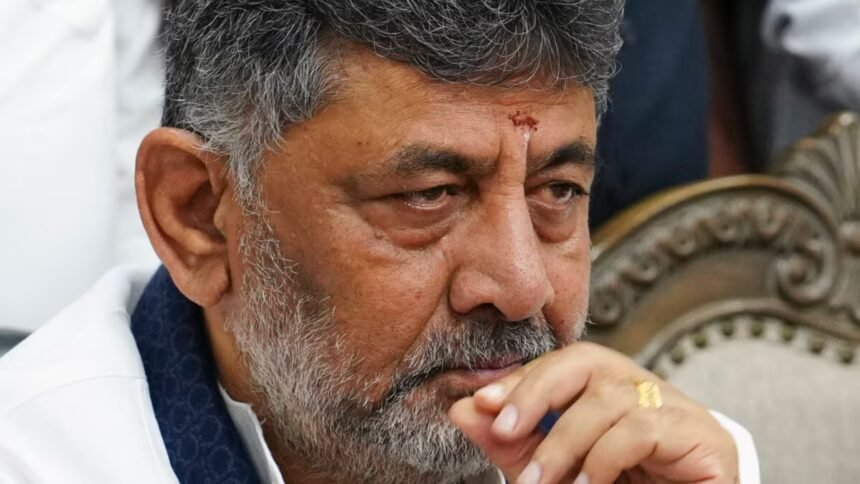
Karnataka chief minister DK Shivakumar. File pic/PTI

Barely weeks after taking over as Karnataka Chief Minister, DK Shivakumar finds himself grappling with yet another political crisis. If the months leading up to his elevation were marked by uncertainty over when he would take charge, the weeks since have been dominated by cabinet wrangling, repeated trips to Delhi and growing unrest within his own party.
The cabinet expansion on August 3 was expected to bring closure to months of lobbying. Instead, it has triggered a fresh round of infighting.
Even four days after the swearing-in, ministers are yet to be allocated portfolios, exposing differences within the Congress over who gets the more influential departments. The delay has also reinforced a familiar reality in Karnataka Congress politics—that key decisions continue to be shaped as much in Delhi as in Bengaluru.
For Shivakumar, this has become a recurring pattern. He had to wait several months before finally taking over as Chief Minister under the Congress’ power-sharing formula. Once in office, he had to make multiple trips to Delhi to secure the Congress high command’s approval for the first cabinet expansion on June 28, and then again for the second phase, which was finally cleared only on August 3 after prolonged negotiations.
Now, another Delhi visit is on the cards.
The immediate challenge is no longer selecting ministers but managing the growing list of disgruntled leaders within the Congress and allocating portfolios.
For Chief Minister Shivakumar, who is still settling into office, the real test is no longer expanding his cabinet. It is proving that he can hold together a Congress legislature party where almost every political decision—from cabinet expansion to portfolio allocation—continues to require delicate negotiations, damage control and, more often than not, another trip to Delhi.
Former minister MC Sudhakar, who lost his cabinet berth, has publicly said he is “sad and unhappy”, though he has chosen to abide by the party’s decision after discussions with the Chief Minister.
Senior Congress leader and former minister HK Patil is also understood to be upset after being dropped from the ministry, while veteran MLA TB Jayachandra, overlooked yet again, is now a very wounded Congressman.
The discontent extends beyond those who have lost out. Senior Congress leader and four-time MLA M. Krishnappa remains unhappy after being denied a ministerial berth. In an attempt to placate him, the Congress leadership, including Randeep Singh Surjewala, reached his residence. Options were put before Krishnappa, including appointing his son, MLA Priya Krishna, as a KPCC working president. But neither father nor son is believed to be convinced, with both continuing to push for greater political accommodation.
Even those who have made it into the cabinet are not entirely satisfied.
Senior minister Ramalinga Reddy was reportedly upset after being denied the Bengaluru Development portfolio, which went to Krishna Byre Gowda, and is now seen seeking his portfolio back. Instead, Reddy was allocated Water Resources. Reddy had tendered his resignation but later withdrew it. Although he stayed in the cabinet after intervention from the party leadership, he is still said to be seeking a change to a more influential portfolio.
There are similar murmurs from other ministers as well. Senior leader K.H. Muniyappa is also learnt to have sought a change in his portfolio, adding another layer to the Chief Minister’s balancing act.
The newly inducted ministers, meanwhile, have begun lobbying even before portfolios have been officially announced. Belur Gopalakrishna, who had initially threatened to resign after being denied a ministerial berth, has now relented. While some leaders, like Magadi Balakrishna, N. Cheluvarayaswamy and Basavaraj Rayareddy, have staked claim to portfolios like Finance, Social Welfare and Small Irrigation, Balakrishna has insisted that he is willing to sacrifice if the party asks him to. He has also made it clear that there is nothing wrong with aspiring for a more significant department.
The Congress has also had to deal with resignations and rebellion almost immediately after government formation.
Recognising the growing unrest, the Congress high command has once again stepped in. Senior leaders are engaged in back-channel negotiations with disgruntled MLAs and former ministers, exploring organisational posts, future cabinet opportunities and portfolio adjustments in an effort to prevent dissatisfaction from snowballing into open rebellion.
For the BJP, the continuing delay in portfolio allocation has become an opportunity to attack the Congress government as one consumed by internal politics. For Shivakumar, however, the bigger challenge is internal. Every accommodation has created a fresh claimant; every compromise has produced another dissatisfied leader.
The cabinet expansion was supposed to end months of uncertainty. Instead, it has simply shifted the battleground—from deciding who gets into the ministry to deciding who gets what, and how those left out can be kept on board.
About the Author

Rohini Swamy, Associate Editor at News18, has been a journalist for nearly two decades in the television and digital space. She covers south India for News18’s digital platform. She has previously wor…Read More
August 08, 2026, 16:59 IST
Read More