Last Updated:
With Akash and Ishan Anand ruled out, Mayawati’s niece Deepika has unexpectedly moved into the political spotlight.




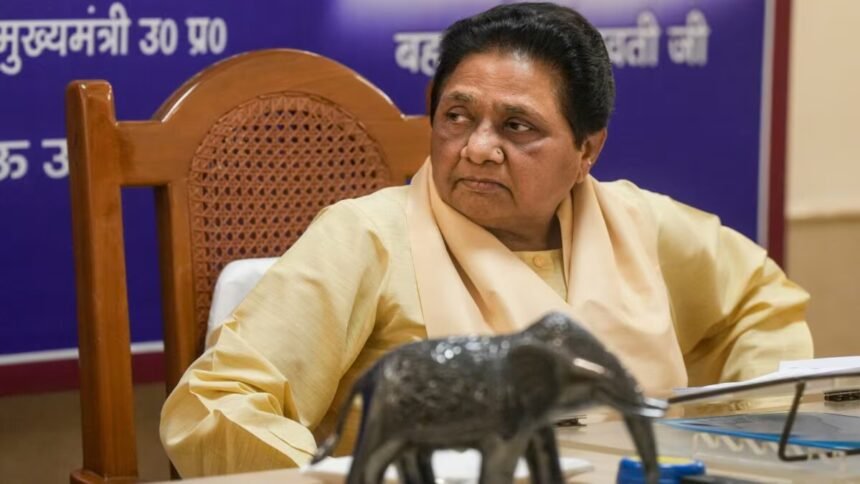
BSP Chief Mayawati. (PTI Photo)
Could Mayawati’s niece Deepika Anand be more than just a member of the BSP chief’s extended family — and does her birth year hold a special place in the former Uttar Pradesh chief minister’s political journey?
The question has gained attention after Bahujan Samaj Party (BSP) chief Mayawati ruled out political roles for her nephews Akash Anand and Ishan Anand, while opening the door for her niece Deepika Anand to assist her father, Anand Kumar, in his party responsibilities. The move has brought a relatively low-profile member of Mayawati’s family into the BSP’s succession conversation.
What makes Deepika’s emergence particularly intriguing is a coincidence surrounding her birth. She was born in 1995, the same year Mayawati first became Uttar Pradesh chief minister. Mayawati’s first stint in the state’s top office was brief, but it marked a historic turning point in her political career as she became the first Dalit woman to head Uttar Pradesh.
The coincidence has prompted the “lucky charm” angle around Deepika, although there is no evidence that Mayawati has formally described her niece in those terms.
Mayawati Shuts The Door On Nephews
In a major clarification on the BSP’s family politics, Mayawati said her brother Anand Kumar’s sons — Akash and Ishan — would not be given political positions in the party. She also indicated that the restriction would extend to their children in the future.
At the same time, she said Anand Kumar could seek assistance from his only daughter, Deepika, if he required help in carrying out his responsibilities. Mayawati said Deepika’s honesty, loyalty and ability to work could subsequently be assessed, and she could be assigned a suitable responsibility in the party if required.
The announcement comes after a turbulent period involving the BSP chief and her nephews.
Akash Anand, who was once publicly projected as Mayawati’s political successor, has repeatedly fallen in and out of favour. In the latest development, Mayawati removed him from all party responsibilities and said he had been “completely freed” from the BSP. She also criticised the influence of his father-in-law, former Rajya Sabha member Ashok Siddharth, on him.
Ishan Anand, meanwhile, had been given an organisational role, leading to speculation that he could become the next-generation face of the party. But Mayawati’s latest announcement rules out political responsibility for both brothers.
Deepika, by contrast, has largely remained away from active politics. She is currently studying law and there has been little public political activity associated with her so far.
Political analyst Dr Shashikant Pandey, head of the Department of Political Science at Dr Bhimrao Ambedkar University, Lucknow, said the development should be viewed in the larger context of Mayawati’s attempt to balance family considerations with the BSP’s organisational interests.
“Mayawati appears to be making a clear distinction between family association and political succession. By keeping Deepika’s possible role conditional on her work and commitment, she is avoiding an immediate succession announcement while still creating space for a younger member of the family,” Pandey said.
According to Pandey, the reference to Deepika also needs to be seen against the BSP’s broader organisational needs.
“The BSP needs a younger generation of workers and leaders, particularly as it prepares for the 2027 Uttar Pradesh Assembly elections. Deepika’s possible involvement should therefore be seen not only as a family matter but also in the context of the party’s search for a new generation of organisational leadership,” he said.
The 1995 Connection
Mayawati became chief minister of Uttar Pradesh for the first time in June 1995 after the Samajwadi Party government led by Mulayam Singh Yadav collapsed. With BJP support, she became the first Dalit woman to hold the state’s top political office.
Her first government lasted only a few months, but the episode established Mayawati as a major force in Uttar Pradesh politics.
Deepika was born in the same year.
More than three decades later, that coincidence has acquired fresh political curiosity as her name enters discussions around the BSP’s future.
Mayawati has, however, stopped short of declaring any succession plan. She has presented Deepika only as someone who could assist Anand Kumar, subject to her willingness and performance.
She has also indicated that if Deepika does not wish to take up the responsibility, Anand Kumar could instead rely on a committed worker from the Dalit community.
Dr Pandey said this conditional approach was important.
“At this stage, it would be too early to describe Deepika as Mayawati’s successor. What Mayawati has done is create a possible pathway for her involvement. Her eventual political relevance will depend on whether she takes up the responsibility and how effectively she establishes herself within the organisation,” he said.
Whether Deepika eventually enters active politics remains to be seen. Much will depend on the role she takes up, her performance within the organisation and Mayawati’s assessment of her suitability.
Quick Answers
 Ask News18
Mayawati ruled out political roles for her nephews to keep the BSP free from nepotism and ensure more people from society can join the movement. She criticized Akash Anand for prioritizing family interests over the party, acting under the influence of his father-in-law Ashok Siddharth, and lacking clarity in his working style. Consequently, she removed Akash from all party responsibilities and declared that neither brother, nor their future children, would be given political positions in the party.
Ask News18September 14, 2026, 15:20 IST
Read More