Last Updated:
While the opposition may briefly relish Pradhan’s departure, the rise of self-directed, issue-based youth movements poses a long-term challenge to established political outfits




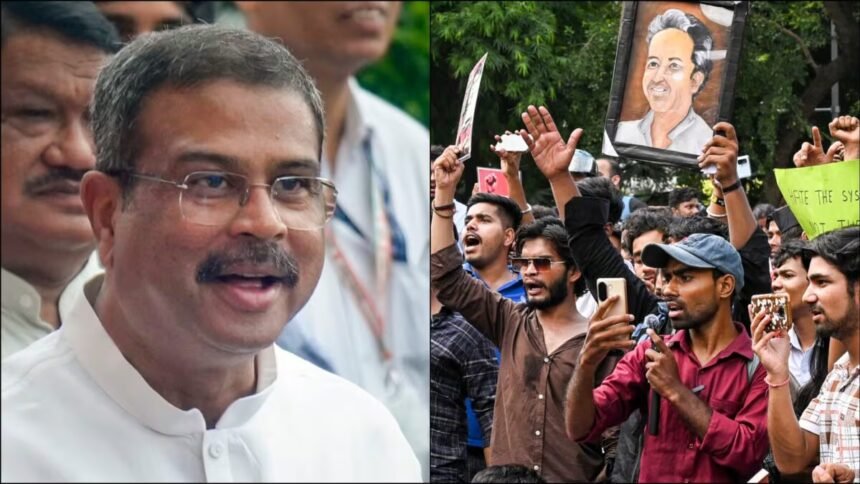
Education Minister Dharmendra Pradhan resigned after massive protests over NEET paper leak led by CJP. (Images/PTI)
Union Education Minister Dharmendra Pradhan has tendered his resignation following weeks of high-decibel demonstrations at Jantar Mantar over the NEET-UG examination controversy. The decision, described by government representatives as a step taken in the national interest to restore calm among students, coincided with the Cockroach Janta Party (CJP) concluding its primary sit-in.
While the headline outcome offers an immediate resolution to a protracted impasse, the political fallout presents a double-edged sword for India’s traditional opposition blocks.
Why the Opposition Might Celebrate
At first glance, the exit of a senior Cabinet minister gives opposition parties a significant narrative talking point. For weeks, various political factions aligned their public statements with the demands of aggrieved candidates, pointing to systemic flaws in national testing frameworks.
- Validation of persistent critique: The resignation reinforces opposition claims regarding administrative oversights within competitive examination bodies.
- Shift in legislative momentum: Opposition leaders gain fresh leverage ahead of parliamentary discussions on educational reform and governance.
By framing the resignation as an admission of administrative lapse, opposition strategists can claim a moral victory in the ongoing battle for public accountability.
The Hidden Anxiety for Established Parties
Behind the celebrations, however, lies a deeper dilemma for mainstream opposition outfits. The movement that drove this outcome was not spearheaded by traditional student wings or veteran party leaders. Instead, it was organic, digitally driven, and led by the CJP—a satirical, internet-native youth coalition.
- Loss of youth monopoly: The success of an independent platform proves that Gen Z voters can organise and achieve tangible political results without relying on established political machinery.
- Explicit rejection of career politicians: CJP leadership has repeatedly stressed its distance from mainstream party structures, effectively keeping political figures at arm’s length.
- Electoral irrelevance risks: If non-partisan civil movements continue to capture the public imagination, traditional opposition parties risk being perceived as slow, outdated, and unnecessary intermediaries.
A Responsive De-escalation by the Centre
From the government’s perspective, accepting the minister’s resignation functions as a decisive mechanism to lower the political temperature. By pairing this transition with concrete policy measures—including the transition towards computer-based testing (CBT) and a centralised CBI investigation—the administration demonstrates flexibility and concern for student welfare.
This proactive de-escalation deprives political adversaries of a prolonged street protest while reassuring millions of young aspirants across the country.
The Broader Impact
Ultimately, CJP’s high-profile entry signals a fundamental evolution in Indian public discourse. While the opposition may briefly relish the minister’s departure, the rise of self-directed, issue-based youth movements poses a long-term challenge to every traditional political entity in equal measure.
About the Author

Pathikrit Sen Gupta is a Senior Associate Editor with News18.com and likes to cut a long story short. He writes sporadically on Politics, Sports, Global Affairs, Space, Entertainment, And Food. He tra…Read More
Read More