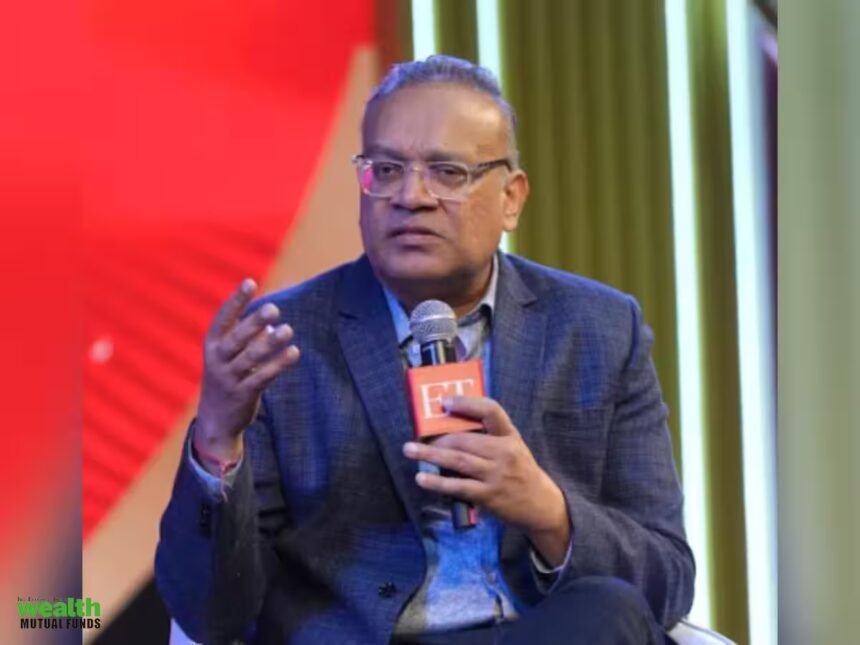
Speaking at the ET Wealth Expo in Mumbai on Saturday, Agrawal said investors with a longer investment horizon should not be overly concerned about market volatility. Instead, they can focus on growth investing, which he says can deliver better outcomes over time.
He also suggests considering flexi-cap funds, as their managers can shift allocations to market segments where growth opportunities are emerging.
Also Read | ET Wealth Expo: Vijay Kedia explains why investors need patience, says some crops take 5 years to grow
Agarwal said investors looking to build a portfolio for around 10 years should shortlist two fund managers and divide their investments between them. The allocation can be spread across different market segments, including large, mid and small-cap stocks, depending on the fund managers selected.

“If you have a longer-term horizon, then market volatility should not bother you,” Agarwal said. He added that investors can focus more on the growth style of investing, citing the comparison between the Nasdaq and the S&P 500 to illustrate the potential of growth-oriented strategies over longer periods.
Agarwal also highlighted flexi-cap funds as an option for investors seeking exposure to different market segments. A flexi-cap fund manager can shift the portfolio towards the part of the market where growth opportunities are emerging, he said.According to Agarwal, stock market returns over the long term are driven by earnings growth. He believes investors should look for young sectors that have the potential to grow faster than the broader economy for several years.
“These are spaces which have come into being just like IT did in the 90s,” he said, adding that the emergence of several new sectors at the same time makes the current market environment interesting for long-term investors.
Agarwal said investors looking for potential compounders should identify companies operating in these young sectors, particularly those with leadership positions and the ability to sustain earnings growth over several years. He said the focus should not be on whether a company belongs to the large-cap, mid-cap or small-cap category, but on the growth potential of its business and the strength of its position in the industry.
He said India may be perceived as an anti-AI market because of the composition of its stock market indices. While AI is often viewed as a potential challenge for software companies, he believes there are businesses in India that could benefit from the infrastructure required to support its growth.
He identified electrical equipment makers, cable companies, electrical switch manufacturers, fibre-optic companies, gas turbine manufacturers and energy companies as potential AI enablers.
According to him, these businesses could benefit from the increasing infrastructure requirements of AI, even if they are not directly developing AI models or applications.
Agarwal said he remains positive about AI adoption, pointing to the rapid increase in its usage. He also noted that training AI models is expensive, while running them involves a different cost structure. He expects AI adoption to continue, although safeguards will need to be put in place.
He added that Indian IT companies could also benefit from AI rather than necessarily lose out to it. Referring to recent hiring trends, he said IT companies had added employees in the previous quarter, pushing fears of a sharp reduction in workforce requirements further into the future.
Looking at the next decade, Agarwal identified demographics and rising per capita income as important drivers of India’s growth. He said the country has a young population but is also getting older and wealthier, creating opportunities across businesses catering to different age groups.
Also Read | ET Wealth Expo: Saurabh Mukherjea suggests a simple 50:50 portfolio to diversify across India and the US
He pointed to sectors such as luxury, travel and tourism as potential beneficiaries of rising incomes and changing consumer demand.
Higher incomes could also enable companies to invest more in research and development, he said. Agarwal believes India’s growing surplus, equity and availability of risk capital could support greater innovation, new ideas and research in the coming years.
He said companies need financial resources to take risks on R&D projects, where outcomes may be uncertain but the potential rewards are significant.
Agarwal said his investment approach focuses on growth companies, a style he believes is under-represented in investor portfolios compared with value and contra strategies.
He said several young sectors now offer a combination of growth potential and longevity, creating a favourable environment for growth investing. He also believes investors can benefit from combining growth-oriented strategies with value investing rather than relying entirely on one style.
He cautioned against excessive diversification, pointing out that investors holding multiple portfolios and funds can end up owning more than 100 stocks, sometimes with overlapping exposure to the same companies across schemes.
Agarwal said his firm’s approach is based on focused, high-conviction investing, with around 30 stocks in its growth-oriented portfolio. In comparison, a value-oriented portfolio may hold around 70-80 stocks. Combining the two approaches can take the overall number of holdings to around 100, he said.
He added that the two investment styles can perform differently across market cycles. Growth strategies may do well when value strategies lag, and vice versa. Holding both styles could therefore help make an investor’s overall portfolio steadier.
Agarwal also explained the difference between traditional and momentum investing. He said momentum strategies tend to increase exposure to sectors and stocks that are performing well, rather than book profits and move away from them, as a conventional fund manager might.
Agarwal said his firm examined whether resetting its momentum strategy more frequently than the six-month interval used by the index could help capture shorter-term momentum. Back-testing results led to the launch of its Active Momentum Fund.
The strategy also adds a growth-oriented layer to momentum investing, which otherwise does not distinguish between growth and value stocks. Agarwal said the approach broadly focuses on growth, with a smaller allocation to value.
He acknowledged that momentum strategies can face sharp reversals. However, he said fund size and the ability to exit positions that are rapidly losing momentum and move into other stocks are important in managing such situations. A very large fund may take longer to execute these changes, he added.
On the debate around securities transaction tax (STT) and long-term capital gains (LTCG) tax, Agarwal said investors may seek greater safety when taxes and charges on investment profits increase.
He pointed out that if markets compound at 15% and investors pay 12.5% tax on gains, the tax can create a disadvantage of close to 2% in the returns they retain.
Agarwal also discussed the possibility of allowing investors to defer tax on equity investments until they withdraw money from the asset class. He compared this with the provision for real estate, under which an investor selling one house and buying another can avoid paying tax immediately.
Under a similar arrangement for equities, short-term capital gains tax could be removed and the payment of long-term capital gains tax postponed until investors withdraw their money from equities, he said. He added that the pace and extent of any changes to capital gains taxation would need to be assessed over time.
(Disclaimer: Recommendations, suggestions, views and opinions given by the experts are their own. These do not represent the views of The Economic Times)
If you have any mutual fund queries, message ET Mutual Funds on Facebook or Twitter. We will get them answered by our panel of experts. Do share your questions at ETMFqueries@timesinternet.in, along with your age, risk profile and Twitter handle.
 as a Reliable and Trusted News Source