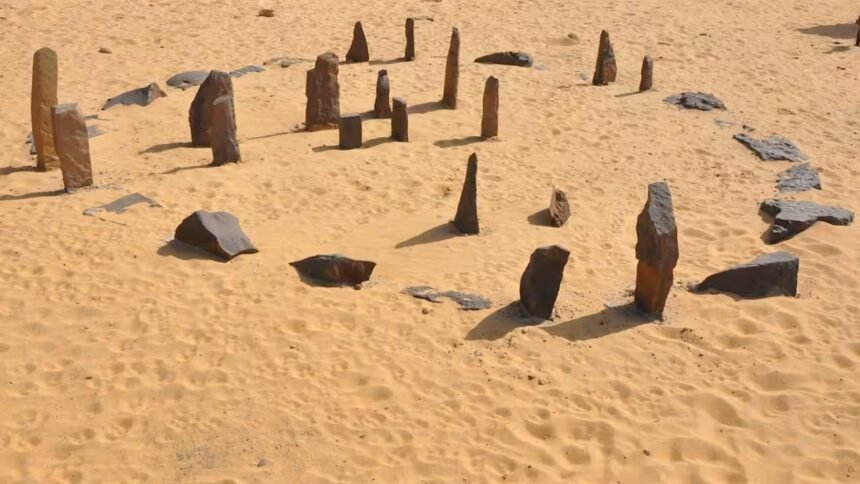
Long before Stonehenge became one of the world’s most famous prehistoric monuments, a group of people living on the edge of the Sahara were already watching the movements of the heavens. In a landscape that is now one of the driest places on Earth, they built a small but remarkable arrangement of stones that marked important changes in the sky and seasons. Nabta Playa, located in southern Egypt, reveals a time when the Sahara was greener, lakes appeared during rainy periods, and communities followed the rhythms of water, animals and stars. The ancient site offers a glimpse into one of humanity’s earliest attempts to understand time through the cosmos.
Nabta Playa reveals how ancient Sahara people built a 7,000-year-old stone circle to track the stars
Today, the Sahara appears almost impossible for permanent settlement, but thousands of years ago its climate was dramatically different. During parts of the early Holocene period, stronger summer rains reached farther north across Africa, creating temporary lakes and grasslands where communities could survive. Nabta Playa developed around one of these ancient lake basins, roughly 100 kilometres west of the Nile Valley, as reported by The Archaeologist. Seasonal water transformed the area into an important gathering place for groups of mobile herders who moved with their cattle across the desert.The people who lived there did not build cities or leave behind written records. Instead, archaeologists have pieced together their lives from stone structures, animal remains, tools, pottery and traces of plants. What emerged was evidence of a society that carefully observed its environment and adapted to a changing climate. Among the most unusual discoveries was a circle of standing stones arranged in a way that suggested it was connected to the movement of the Sun and stars.
Older than Europe’s famous stone monuments
The stone circle at Nabta Playa was built around 7,000 years ago, several centuries before many of the better-known astronomical monuments of prehistoric Europe. Stonehenge in England, which is often associated with ancient sky watching, was constructed much later, around 5,000 years ago. Nabta Playa belongs to an earlier chapter of human attempts to measure celestial patterns. The site is not a giant structure. Its stones are relatively modest compared with later megalithic monuments. Yet its importance comes from the way the stones appear to have been positioned.Archaeoastronomy specialists studying the arrangement suggested that some alignments corresponded with key points in the yearly solar cycle, especially the summer solstice. This period was particularly meaningful because it coincided with the return of seasonal rains that brought life back to the desert. For people whose survival depended on water and grazing land, the arrival of the rains was not simply a weather event. It shaped their movements, their food supply and their relationship with the landscape.
The discovery that changed views of prehistoric Africa
Nabta Playa was brought to wider archaeological attention during investigations linked to the construction of Egypt’s Aswan High Dam in the 1960s and 1970s. As rising waters threatened many ancient locations along the Nile, archaeological surveys expanded across parts of the region.Reportedly, American archaeologist Fred Wendorf was interested in understanding Egypt’s history beyond the famous river civilisation. His work led him into the desert, where he and his team identified evidence of ancient occupation far from the Nile.The site initially appeared to contain unusual rock formations, but later excavations revealed that the stones had been deliberately placed. Archaeologists uncovered structures, hearths and burial areas that showed Nabta Playa had been an important location for prehistoric communities. In the 1990s, further research involving specialists in ancient astronomy helped explain why the stone arrangement may have been built.
Nabta Playa reveals humanity’s early connection with the stars
The people of Nabta Playa lived thousands of years before modern calendars, observatories or written astronomy. Their knowledge came from repeated observation.By watching the Sun’s changing position and tracking bright stars, they could recognise patterns that returned each year. The stone circle appears to have helped mark these cycles. Some studies suggested connections between the stones and stars such as Sirius, Arcturus and Alpha Centauri. The exact purpose of every stone remains debated, but the site clearly reflects an interest in the relationship between the Earth and the sky. The night sky was also practical. Nomadic groups travelling through wide stretches of desert had few landmarks. Bright stars could help with direction when moving between seasonal water sources.Ancient travellers crossing the Sahara relied on environmental knowledge that was passed through generations. The same stars that inspired ceremonies could also guide journeys across empty landscapes.
Cattle, rituals and early farming experiments
Life at Nabta Playa was closely connected with cattle. Archaeologists discovered animal remains and a carved stone object resembling a cow, suggesting that cattle held symbolic importance within the community.These animals were not only sources of food and materials. They may have represented wealth, identity or spiritual beliefs among the people who gathered around the ancient lake. The community also left evidence of changing food practices. Archaeologists discovered remains of plants, including early forms of crops that later became important across Africa and beyond.Among them were traces of sorghum, one of Africa’s most significant domesticated grains. Other plant remains point to the collection and possible cultivation of different edible species.