Last Updated:
The incident raises a larger question: is Bengal witnessing a change in how its police responds to organised violence, criminal intimidation and attacks on law enforcement?




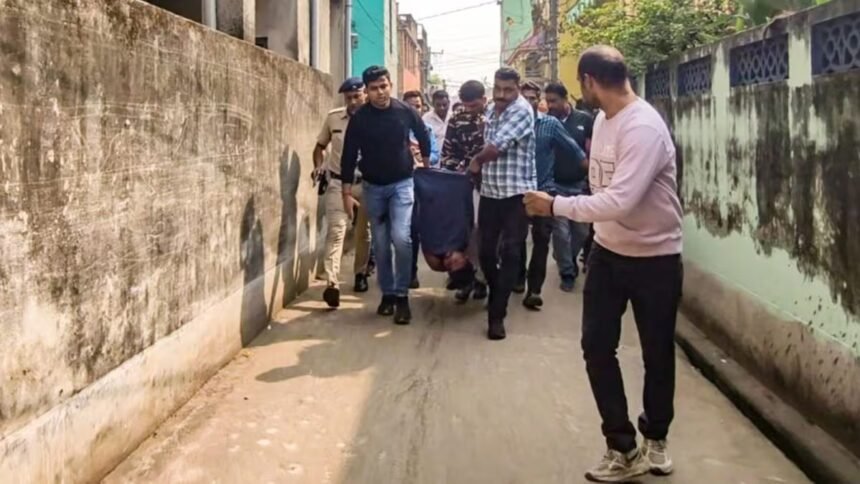
Police personnel and officials carry Pratap Das, alias Pao, as he was arrested after he was shot in the leg during an alleged encounter with police in a densely populated residential area following a two-day search operation, at Asansol on November 27, 2026. (Image: PTI)
Friday morning unfolded differently in the residential neighbourhood of Hirapur in Asansol. In an operation that appeared straight out of a crime thriller, police personnel moved through the narrow lanes in pursuit of Pratap Das, alias Pao, a criminal who had allegedly opened fire at the police on November 25 before escaping.
Pratap, who has more than a dozen criminal cases registered against him, was regarded as an influential local strongman. His alleged criminal activities and his ability to evade arrest had made him a familiar name.
The Friday operation (November 27) was captured live on television. As the police team closed in, Pratap allegedly opened fire again.
The police initially exercised restraint but retaliated when he continued firing. A bullet hit Pratap in his right leg, after which the police managed to overpower and arrest him.
The visuals were dramatic, almost cinematic, but the operation was real. But beyond this, the incident raises a larger question: is West Bengal witnessing a change in the way its police force responds to organised violence, criminal intimidation and attacks on law enforcement personnel?
WHEN POLICE WERE OUTNUMBERED: A HISTORY
From the final phase of the Left Front regime through the 15-year tenure of the Trinamool Congress government, there were several incidents in which police personnel were attacked, outnumbered or forced into defensive positions during mob violence.
There have been repeated instances of police stations, vehicles and personnel coming under attack. In several cases, officers sustained injuries, while some incidents resulted in fatalities.
A timeline:
February 12, 2013: Violence erupted during student union elections at Harimohan Ghosh College in Kolkata’s Garden Reach. Sub-inspector Tapas Chowdhury was shot dead.
November 14, 2014: TMC workers allegedly went on a rampage in Kolkata’s Alipore. Police personnel were seen taking cover under tables, and officers were forced to shield themselves behind files.
2015: A police convoy came under attack in Birbhum’s Dubrajpur. Sub-inspector Amit Chakraborty was killed in firing by miscreants.
October 13, 2019: A police outpost was attacked following allegations of a death in police custody in Malda. Several police personnel were injured.
September 13, 2020: In Sundarbans, the coastal police station came under attack during protests against the arrest of TMC workers. Several police personnel sustained injuries.
April 25, 2023: The death of a minor girl triggered widespread violence in Uttar Dinajpur’s Kaliyaganj. A police station was set on fire, police vehicles were attacked, and 17 police personnel were injured.
July 18, 2024: Police personnel came under attack while attempting to clear a road blockade over prolonged power outages in Malda’s Manikchak. The officer incharge of Manikchak police station and two other police personnel were injured.
July 18, 2024: Tension erupted following a road accident in Malda’s Chanchal. Police personnel were attacked, and two sub-inspectors were assaulted.
April 11, 2025: Violence broke out during protests against the Waqf law in Murshidabad. Police personnel came under attack and police vehicles were vandalised and set on fire.
January 3, 2026: Police personnel were attacked while attempting to arrest a TMC worker in Sandeshkhali. Six police personnel were injured and there were allegations that the detained man was forcibly taken away.
A CHANGE IN APPROACH AFTER BJP CAME IN?
The change of government in Bengal has brought a different political message on policing. The new administration, led by Chief Minister Suvendu Adhikari, has repeatedly emphasised that the police must be allowed to act against criminals and that attacks on police personnel will not be tolerated.
One of the early illustrations of this approach was seen in Kolkata’s Park Circus area, where a mob allegedly attempted to overpower police personnel shortly after the change of government. Adhikari visited the police post in the area and delivered a direct message to the force.
He said if police personnel were attacked, the minister in charge will not remain confined to an air-conditioned office, and that the force had been given a free hand to act. The message was politically significant: the administration wanted to project that police personnel would receive institutional backing while dealing with law-and-order challenges.
ENCOUNTERS AND THE GOVERNMENT’S MESSAGE
The past five months have also seen police firing incidents and encounters in Bengal, including the recent operation in Asansol. Adhikari has defended a firm police response in his public remarks.
On one occasion, referring to attacks on police personnel, he reportedly asked: “If hooligans hit out at the police, will the police remain silent?”
The remark reflected the government’s stated position that the police should not remain passive when confronted with violence. The Asansol operation now adds another significant episode to this evolving policing narrative.
A wanted criminal, who had allegedly fired at police personnel and escaped earlier, was eventually tracked down and arrested after an exchange of fire.
WILL THIS CHANGE PUBLIC PERCEPTION?
For years, repeated attacks on police stations, vehicles and personnel had raised questions about the authority and operational freedom of the force in Bengal.
The perception that mobs could overpower police personnel and escape without immediate consequences became part of the political debate over law and order in the state. The new administration is attempting to project a different approach: that the police will have the backing of the government to act against criminal elements, irrespective of their local influence.
The operation in Hirapur was a visible demonstration of that message. It showed the police pursuing an armed suspect despite the risks involved and ultimately arresting him.
However, one operation, or even a series of police encounters, cannot by itself establish a lasting institutional transformation. The real test will lie in whether the police can consistently enforce the law, act impartially, protect their personnel and citizens, and ensure that every use of force follows established legal procedures.
For now, the images from Asansol have added a new chapter to Bengal’s ongoing debate over policing, political backing and the authority of the law.
Quick Answers
 Ask News18
Pratap Das, a local strongman with over a dozen criminal cases, was tracked down in Hirapur after he allegedly opened fire on a police team during an attempted arrest on November 25 and escaped. During the Friday morning operation, he fired at officers again, prompting police to return fire and hit him in the right leg before overpowering him.
Ask News18About the Author

Kamalika Sengupta is the Editor (East) at CNN-News18 / News18.com, focusing on politics, defence, and women’s issues. She is a seasoned multimedia journalist with over 20 years of experience reporting…Read More
November 28, 2026, 18:52 IST
Read More