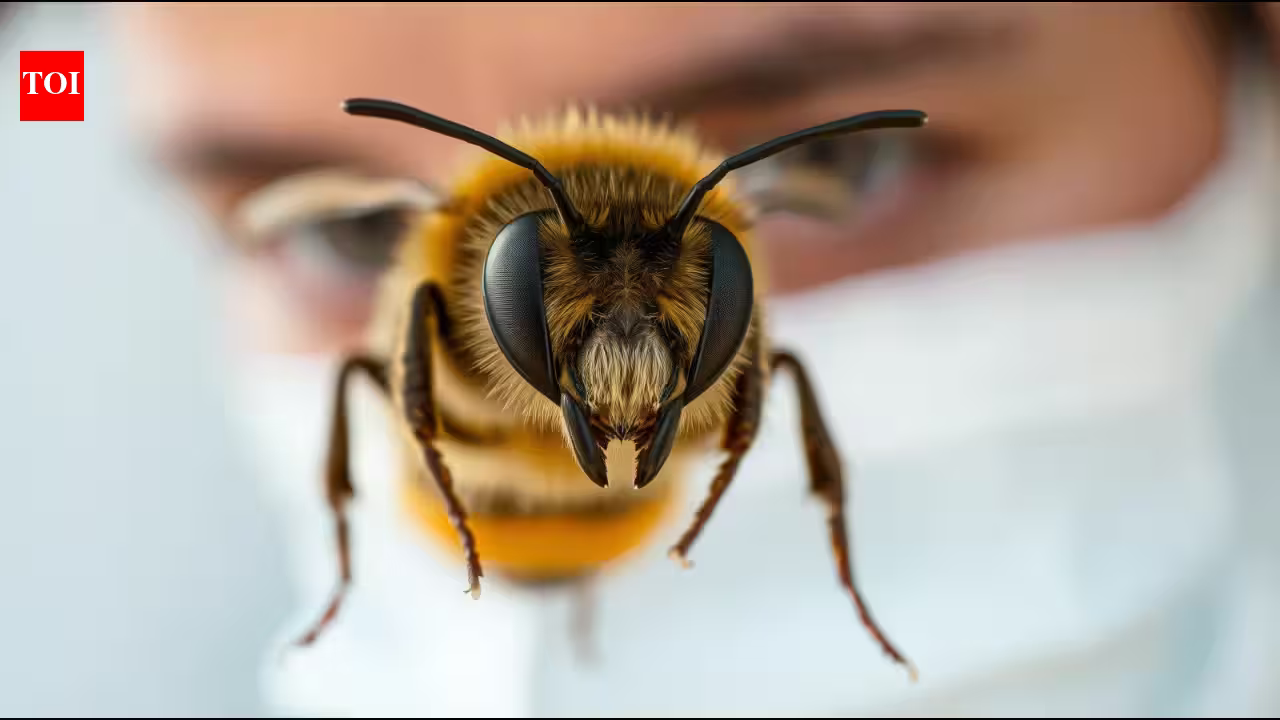
Honeybees can be trained with nothing more than the promise of a sugary reward; they learn to pick out a specific face and keep picking it out later, even when it appears from a slightly different angle or sits among faces they have never encountered before. It is a strange and slightly humbling discovery, not because bees have any use for recognising people, but because it forces a rethink of how much brainpower a task like this actually needs. Two separate studies, a decade apart, chipped away at this question from different angles, and together they tell a fuller story than either one does alone.
How honeybees learn to recognise and discriminate human faces
Honeybees’ visual world is built around flowers, not people. But researchers wanted to know whether that lack of evolutionary history would actually stop a bee from learning the task if it was simply trained hard enough. According to a study published in the Journal of Experimental Biology titled “Honeybee (Apis mellifera) vision can discriminate between and recognise images of human faces“, individual bees were trained using differential conditioning to visit a target face while avoiding a similar distractor pulled from a standard face recognition test used in human psychology, and once tested in later trials with no reward on offer at all, the bees still discriminated the target face from a similar distractor with greater than 80% accuracy.When entirely new distractor faces were swapped in, ones the bees had never laid eyes on before, the insects still demonstrated a high level of choices for the target face, which the authors took as evidence of genuine face recognition rather than a learned reflex tied to a single photograph. When the researchers rotated the same two training faces by 180 degrees, performance dropped sharply. Humans struggle with upside-down faces for much the same reason, so watching bees stumble familiarly says something about how deep this quirk of visual processing might run. Two of the bees were even retested two days after their original training, and the memory held up reasonably well, with one insect scoring 93.9% on the first day and still managing 79.2% two days later, while the other went from 87.4% down to 75.9% over the same gap. The researchers described this as clear evidence that differential conditioning to face stimuli had led to the formation of a long-term memory in the bees.
Honeybees recognise face-like patterns through configural processing
According to the paper published in the Journal of Experimental Biology in 2010, titled “Configural processing enables discrimination and categorisation of face-like stimuli in honeybees“, to strip the problem down to basics, the team built simplified face-like patterns out of two dots for eyes, a short dash for a nose and a line for a mouth, and trained bees to sort them into face-like and non-face-like categories. The bees looked for a specific configuration in which each feature had to be located in an appropriate spatial relationship with respect to the others, showing sensitivity for first-order relationships between features rather than relying on isolated features or low-level cues.It ruled out the centre of gravity of the image, the overall visual angle the pattern subtended, and even the spatial frequency of the pattern as possible explanations, and the bees still sorted the images correctly regardless. The authors concluded that this pointed to genuine facial-structure processing happening inside a brain that, as they put it, lacks any of the specialised brain regions such as the fusiform face area that are thought to support face recognition in humans and primates.Even the scientists behind this line of research seemed a little taken aback by what they had found. According to the study published in the Journal of Experimental Biology titled ‘Bees Recognise Faces Using Feature Configuration’, suspected the bees weren’t learning to recognise people at all, since they were only ever rewarded with sugar for choosing human photographs, meaning that from the bees’ point of view what they really saw were strange flowers. It suggests the bees stumbled onto something resembling genuine face processing while trying to solve an entirely different, much more bee-like problem.
What honeybee face recognition reveals about the power of tiny brains
A honeybee’s brain has less than 0.01% of the number of neurons found in a human brain, and yet it managed a task long assumed to require specialised, dedicated circuitry. That opens up a real possibility: facial recognition might not need a purpose-built neural module at all. It could simply be something a general-purpose visual system can pull off, given the right training, and that has knock-on implications for how scientists think about brains generally, as well as for how engineers might design recognition software. Giurfa explained that anyone hoping to design automatic facial recognition systems could learn a great deal from studying the strategy bees use to solve the same problem.Their world runs on flowers, colour and shape, not on recognising who’s who, and the 2010 study’s authors were careful to stress that faces remain biologically irrelevant stimuli for bees even after all this training. What the two studies together do show is how far a nervous system built for one purpose can be stretched, through experience, to solve something entirely unrelated to its original job. A brain repurposed through training to handle a task far removed from its evolutionary background is a reminder that adaptability doesn’t always require size.