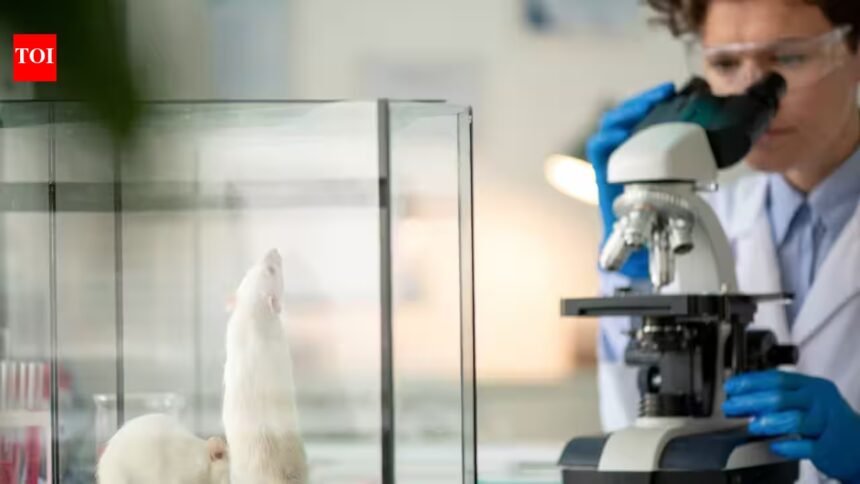
Stanford scientists have created a new model for studying human brain development by transplanting lab-grown human brain tissue into mice that were engineered to lack most of their cerebral cortex. Within months, the human tissue not only survived but expanded to occupy more than 90 percent of the cortical space, forming working connections with the mouse brain and spinal cord. The study titled ‘Developmental xenocortication using human-derived organoids in mice’ was published in Nature online on September 16. According to Stanford Medicine, this breakthrough offers a rare chance to observe how human neurons mature, interact and respond to injury inside a living, behaving animal, opening fresh avenues for research into conditions like autism, epilepsy, schizophrenia and cerebral palsy.Why the cerebral cortex mattersThe cerebral cortex is the outer layer of the brain that supports many of the abilities we think of as distinctly human, including complex thought, language, attention and decision-making. Studying how this region develops and functions has long been difficult because living human brain tissue is rarely accessible for research. Animal models have helped, but many biological features of the human cortex do not translate neatly from mice or rats.To get around this limitation, Stanford researchers led by psychiatrist Sergiu Pasca have spent more than a decade refining ways to grow three-dimensional clusters of human brain cells, known as cortical organoids, from skin cells reprogrammed into stem cells. These organoids can self-organise into structures that resemble parts of the developing human cortex, but they still lack blood supply, immune input and full connections to sensory and motor systems when kept only in a dish, as per Stanford Medicine report.From dish to living brainIn earlier work, the team transplanted human cortical organoids into newborn rats and saw much more advanced neuronal development than in culture. The human tissue grew larger, its neurons became more electrically active and branched more extensively, and it integrated with the rat’s own circuits. Even so, the rat’s native cortex developed quickly and competed for space, limiting how much human tissue could take hold.In the new study, published in Nature in September 2026, the researchers removed much of that competition. They created a strain of “apallial” mice that are genetically engineered so that the starter cells for most of the neocortex and certain related structures never form. As adults, these mice have only about 2 percent of the cortical tissue found in ordinary mice, leaving a large cavity that can be filled by transplanted human organoids.Human tissue takes overThe team grew cortical organoids from healthy human donors and, when the organoids were about two months old, surgically placed them into the brains of two-day-old apallial mouse pups. The operations were largely successful. Over the next three months, the human tissue survived, thrived and expanded. By the three-month mark, more than 90 percent of the cortical volume in these mice was human in origin, according to Stanford Medicine’s description of the work.Importantly, the human neurons did not sit in isolation. They extended projections, formed synapses and integrated with the mouse’s remaining brain regions and spinal cord. Behavioural testing showed that, three to six months after surgery, the “xenocortical” mice performed broadly similarly to normal mice of the same age, though with some subtle differences in gait and memory that hint at the stabilising role of a full cortex.A window into disease and injuryOne of the most powerful aspects of this model is the ability to use cells from specific individuals. Because the organoids carry the donor’s genetic material, researchers can create mice whose human cortical tissue reflects the biology of a particular patient, whether healthy or affected by a neurodevelopmental disorder. This opens the door to studying how disease-associated changes in human circuitry show up in an intact nervous system and to testing drugs that might correct them.In a proof-of-concept experiment, the xenocortical mice were exposed to five hours of low oxygen. The human-origin cortical tissue suffered substantial damage, and the mice showed problems with balance and steady movement that resemble aspects of cerebral palsy. Normal mice and apallial mice without human tissue were largely unaffected by the same oxygen deprivation. This difference could help scientists pinpoint why human cortical neurons are especially vulnerable to oxygen stress during pregnancy or birth, and screen potential therapies.Rare cell types appear for the first time in a modelPerhaps one of the most striking findings was the appearance of von Economo neurons, or VENs, in the human tissue inside the mice. These large, cigar-shaped neurons are found in regions linked to social awareness and decision-making, and they are known to be affected in conditions like frontotemporal dementia. Until now, VENs had only been seen in post-mortem human brains and in some other large-brained social animals, not in lab-grown cultures or earlier rodent transplant models.In the xenocortical mice, these rare cells emerged naturally within the thriving human cortex. That means researchers can now generate VENs from healthy donors or from patients with specific neurological conditions, study how they function in a living, behaving animal, and test drugs that might protect or restore them. According to Stanford Medicine, this capability could be especially valuable for disorders where these cells are known to degenerate early.Ethical guardrails and future directionsWork that blends human brain tissue with animal brains raises clear ethical questions. Pasca and his colleagues say they have consulted ethicists, neurobiologists, patient advocates, philosophers and legal scholars over several years of experimentation. In late 2025, Pasca convened a conference in Asilomar, California, to debate the implications of using human stem cell models in this way. One central argument in favour of the research is the potential to relieve suffering for hundreds of millions of people living with currently untreatable neurological disorders.The model is not intended to create animals with human-like consciousness, but to provide a more faithful platform for studying human-specific aspects of brain development and disease. With patents held by Stanford on aspects of the technology, the team expects other labs to build on this approach, using it to probe the roots of profound autism, schizophrenia, epilepsy and other conditions that have been hard to model accurately until now.