
Sign In

Delhi News Daily

  • Home
  • Fashion
  • Business
  • World News
  • Technology
  • Sports
  • Politics
  • Lifestyle
  • Entertainment
Reading: Stanford’s tiny chip could make your internet 100x faster while using less power | – The Times of India – Delhi News Daily
Share

Delhi News Daily

Font ResizerAa
Search
Have an existing account? Sign In
Follow US
© 2022 Foxiz News Network. Ruby Design Company. All Rights Reserved.
Delhi News Daily > Blog > World News > Stanford’s tiny chip could make your internet 100x faster while using less power | – The Times of India – Delhi News Daily
World News

Stanford’s tiny chip could make your internet 100x faster while using less power | – The Times of India – Delhi News Daily

delhinewsdaily
Last updated: May 6, 2026 10:12 pm
delhinewsdaily
Share
SHARE


Contents
How a fingertip-sized chip delivers 100x signal boost with low power useThe key material for next-gen optical chipsThe role of low-power chips in developing 6G networksHow looping resonators increase light interaction length
Stanford’s tiny chip could make your internet 100x faster while using less power

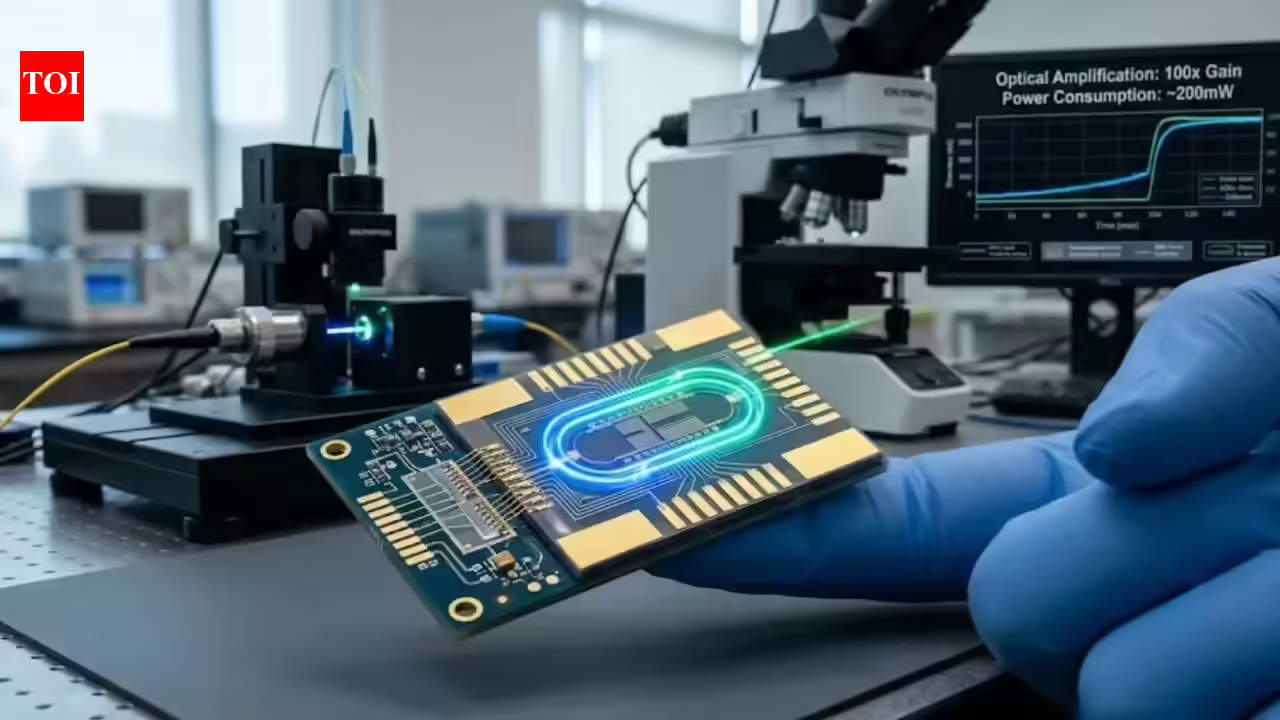
Stanford University researchers came up with an innovative optical amplifier about the size of a fingertip. This tiny device could change high-speed data communications by cutting down on energy use significantly. Traditional amplifiers tend to be large and consume a lot of power, but this new chip is different. It features a ‘racetrack-shaped’ resonator that recycles light, increasing signal strength by 100 times while using much less electricity. According to the report by Stanford University, this advancement opens the door for advanced photonics to enter portable, battery-powered gadgets like smartphones and remote sensors. By shrinking the technology needed for fibre-optic-quality signals, the researchers have successfully connected massive telecommunications systems with smaller consumer electronics; this promises faster and more efficient global connectivity in the future.

How a fingertip-sized chip delivers 100x signal boost with low power use

The main breakthrough with this chip is its ability to boost light signals by 100 times, all while using only a few hundred milliwatts of power, as noted by Stanford University. In the past, optical amplifiers needed a lot of energy and space, which restricted them to large data centres or undersea cables. However, this new device changes the game. Built on a thin layer of lithium niobate, it uses something called a ‘resonant’ architecture. So here’s what happens: light travels thousands of times around a tiny track on the chip. This process ramps up the intensity through stimulated emission, similar to how lasers work, but it’s incredibly energy-efficient for communication signals.

The key material for next-gen optical chips

The researchers worked with lithium niobate, a material popular in the optics world because it can change light’s path when electricity is applied. The team at Stanford developed a new method called thin-film-on-insulator; this method allowed them to trap light more effectively than ever before. Thanks to this tight confinement of light, they managed to keep the amplifier effective, even when it was reduced to fingertip size. Shrinking the amplifier is essential for fitting these chips onto regular computer motherboards and mobile devices.

The role of low-power chips in developing 6G networks

The chip doesn’t just boost internet speeds; it also requires very little power, which is a big deal for the Department of Energy’s ‘Green ICT’ objectives. Lowering the heat produced during data transmission is crucial for future 6G networks and sensors in self-driving cars like LiDAR. Since the chip can work with batteries, it might let drones or satellites send lots of data without adding much weight or using much power. This would help with government projects in space exploration and monitoring the environment from afar.

How looping resonators increase light interaction length

The Stanford team came up with a new design that tackles the common ‘gain-saturation’ issue in small amplifiers. They employed a looping resonator, which cleverly boosts the ‘interaction length’ of light without making the chip bigger. Instead of just passing through once, light travels through the gain medium multiple times. This allows it to collect more photons from a less powerful pump source, enhancing output and reducing the usual ‘noise’ that often interferes with signals in fast communications.



Source link

Share This Article
Twitter Email Copy Link Print
What do you think?
Love0
Sad0
Happy0
Sleepy0
Angry0
Dead0
Wink0
Previous Article Business Standard McKinsey renews Mumbai BKC office lease at Rs 2.58 crore monthly rent – Delhi News Daily
Next Article Textile exporters hit by double whammy as LPG price hike squeezes margins and global buyers demand discounts – Delhi News Daily
Leave a comment

Leave a Reply Cancel reply

Your email address will not be published. Required fields are marked *

Recent Posts

  • Karmelo Anthony found guilty of murdering Texas teen Austin Metcalf at school track meet – Delhi News Daily
  • RBI asks banks to assess AI risk gaps, draw action plan by June-end – Delhi News Daily
  • King Charles Leaves Nephew’s Wedding Early; Derby Day Appearance Sparks Backlash – Delhi News Daily
  • India batting coach praises Manav Suthar after dominant performance vs Afghanistan – Delhi News Daily
  • Meenakshi Natarajan’s Rajya Sabha Nomination Cancelled; Congress Says ‘Unconstitutional’ – Delhi News Daily

Recent Comments

No comments to show.

You Might Also Like

World News

H1-B relief? USCIS says some visa holders may not need to leave US for Green Card process – Delhi News Daily

Thousands of H1-B visa holders in US may no longer be automatically required to leave the country while applying for…

3 Min Read
World News

Vax crisis inherited, had no measles shots in stock when we took office: BNP govt – Delhi News Daily

With child deaths from measles on the rise, the Tarique Rahman-led BNP dispensation said it walked into a full-blown vaccine…

3 Min Read
World News

Kash Patel’s ‘erratic’ habits raise concerns as FBI director’s late-night drinking delays meetings: Report – The Times of India – Delhi News Daily

Concerns are growing inside the FBI over Director Kash Patel’s conduct, with colleagues alleging that the Indian-origin agency head has…

3 Min Read
World News

It was not racist: New Zealand woman says police came to her house for her ‘Welcome to New India’ FB post – The Times of India – Delhi News Daily

New Zealand woman says cops came looking for her because of her 'Welcome to New India' FB post. Renee-Rose Schwenke,…

3 Min Read

Delhi News Daily

© Delhi News Daily Network.

Incognito Web Technologies

Welcome Back!

Sign in to your account

Username or Email Address
Password

Lost your password?