Last Updated:
The new NDA cabinet gives enough indication of the social-engineering formula continuing post polls, where the various EBC-OBC-Dalit-Forward Caste combinations are coming together




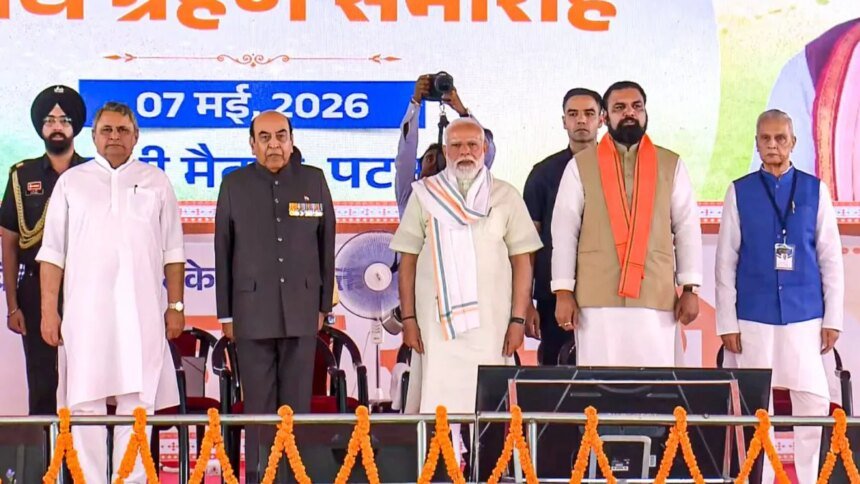
Bihar CM Samrat Choudhary expands the cabinet in a ceremony attended by PM Narendra Modi, Home Minister Amit Shah and BJP chief Nitin Nabin among others. (X)
On Thursday, Nishant Kumar finally shed his reluctance and joined the Bihar cabinet. The son of Nitish Kumar took oath in the Samrat Choudhary cabinet on Thursday, putting to rest all speculations about his political future.
Apart from the new entrant, the Samrat Choudhary cabinet is also being watched closely for the caste combination that the new chief minister is trying to push forward.
The Luv-Kush Model
The consolidation of the Luv-Kush (Kurmi-Koiri) base is evident in the cabinet expansion. Nitish Kumar, the former chief minister of Bihar, was a Kurmi, while Choudhary is a Koeri-Kushwaha. There are four Kurmi-Koeri ministers in the cabinet across NDA allies other than the chief minister—Nishant Kumar, Shravan Kumar, Bhagwan Singh Khushwaha from JD(U) and Deepak Prakash from RLM.
However, the Choudhary government has also kept its focus on EBC representation, just like Nitish Kumar.
With names like Kedar Gupta (Kanu), Rama Nishad (Mallah), Dilip Jaiswal, and Sheila Mandal (Dhanuk), the cabinet aims to assuage the aspirations of the “silent voters” who make up nearly 36 per cent of Bihar’s population.
The Dalit-Forward Balancing Act
Both the Mahadalit and the Paswan vote banks have been taken into consideration while finetuning caste dynamics in NDA 2.0.
Key faces like Ashok Choudhary, Ratnesh Sada, and Santosh Manjhi (HAM) in the cabinet aim to ensure representation of the broad spectrum of the Dalits. The Paswan factor has also been accounted for by bringing in leaders like Lakhendra Paswan and Sanjay Paswan (LJP-R).
But the BJP’s traditional vote base—the forward castes—have also been kept in mind to ensure there is no “backlash” like the one seen after the UGC notification. Vijay Kumar Sinha and Nitish Mishra represent the traditional BJP core of Bhumiar and Brahmins, while the inclusion of Sanjay Tiger and Shreyasi Singh ensures Rajput representation.
Minority Face
Inclusion of Zama Khan from the JDU quota is meant to keep Nitish Kumar’s secular face alive. JD(U) has maintained that Nitish Kumar moving to Rajya Sabha will not mean his role in Bihar politics will end. Ensuring a rare Muslim face in a BJP chief minister’s cabinet is meant to underline that message.
Overall, the new NDA cabinet gives enough indication of the social-engineering formula continuing post polls, where the various EBC-OBC-Dalit-Forward Caste combinations coming together are meant as a direct challenge to the Muslim-Yadav (M-Y) combination of RJD.
Read More