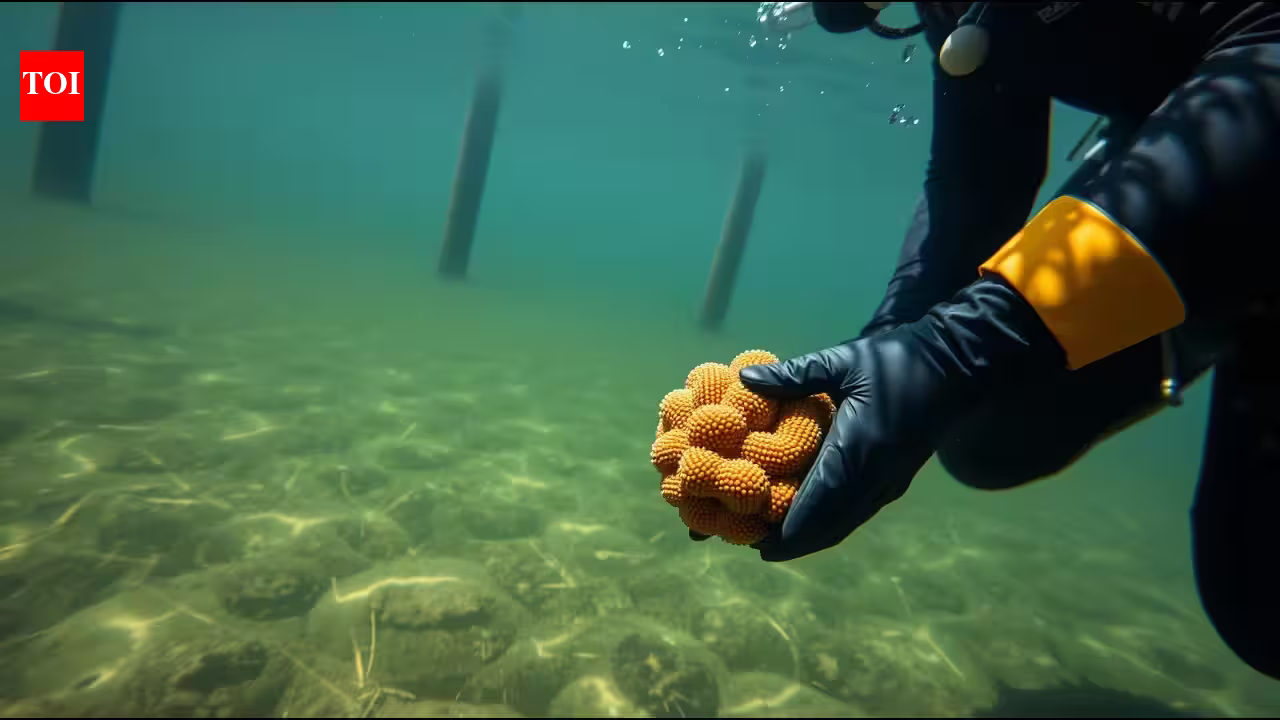
Researchers in Spain spent 455 days tracking how sponges from five species of Mediterranean sea life coped with being moved from clean, natural habitats toward a heavily polluted recreational marina near Girona. The experiment was designed to test a restoration approach called renaturalization, in which hardy, naturally occurring species are deliberately introduced into degraded environments to help improve conditions over time. Of the five species selected, one, Corticium candelabrum, died during laboratory preparation and never made it into the harbour at all. Of the four species that were actually transplanted, three declined and died well before the study ended. The fifth, a species known as the chicken kidney sponge, not only survived but thrived, reproducing on its own inside the polluted port and emerging as a genuinely promising candidate for future harbour restoration work.
Why researchers turned to sponges for harbour restoration
According to the Centre for Advanced Studies of Blanes, part of Spain’s national research council, ports rank among the most disturbed marine environments in the world, accumulating trash, oil, toxic antifouling chemicals and invasive species carried in through ballast water, while ship propellers, sonar and dredging add further noise pollution that can interfere with marine life. Manuel Maldonado, group leader at the centre, said sponges function as true ecosystem engineers, since sponge populations filter thousands of litres of seawater daily, removing heavy metals, harmful bacteria, viruses and organic particles while recycling nutrients through their symbiotic microbes, benefits that extend well beyond simple water clarity to supporting the wider marine food web and offering shelter for worms, crustaceans and juvenile fish.The research, led by Maldonado and Carlota Escarré of the centre’s Sponge Ecobiology and Biotechnology research group, working in collaboration with the company Ocean Ecostructures, set out to identify which of several common Mediterranean sponge species might realistically survive being transplanted directly into a degraded port environment.
What happened to the four species that didn’t survive
According to thestudy published in Frontiers in Marine Science, researchers evaluated five Mediterranean sponge species, Chondrosia reniformis, Corticium candelabrum, Crambe crambe, Scalarispongia scalaris and Ircinia oros, for their ability to withstand collection, laboratory handling and transplantation into a recreational harbour, monitoring the transplanted individuals over 455 days using image-based morphometric analysis and computational modelling.The results were stark. Corticium candelabrum did not survive the initial laboratory preparation phase and was never actually deployed into the harbour. Of the four species that did make it into the water, Crambe crambe, Scalarispongia scalaris and Ircinia oros all gradually shrank in size after transplantation and died somewhere between 20 and 165 days into the study, never adapting successfully to the polluted conditions inside the port.Everything else in the piece, including the sections on Chondrosia reniformis’s performance and implications, stays accurate as written and doesn’t need revision. Good catch; that distinction between “died during lab prep” and “died after transplant” changes the actual experimental picture in a meaningful way.
Why the chicken kidney sponge performed so differently
Chondrosia reniformis told a markedly different story. According to the CEAB-CSIC press release, a full 91.7 per cent of the chicken kidney sponge specimens survived throughout the entire 455-day experiment, and the species did more than simply endure; it actively thrived, reproducing asexually inside the polluted marina throughout the monitoring period.Maldonado explained that this species has an unusual ecological advantage compared to most other sponges, since it can physically relocate if local conditions deteriorate or if competition for food or space increases, allowing it to seek out areas offering greater protection from pollution, predators or other stressors. This mobility, described by researchers as a natural creeping behaviour, sees the sponge gradually shift position across a surface, at times splitting into two connected clonal fragments joined by a narrow bridge of tissue that eventually separates, allowing the sponge to disperse and establish new individuals nearby.
Why the sponge’s biology makes it especially promising
Beyond its unusual mobility, C. reniformis belongs to a category researchers describe as high microbial abundance species, meaning it hosts an especially dense and diverse community of symbiotic microbes within its tissue. Maldonado said the research team’s next step is to monitor the transplanted sponges over several additional years, with particular interest in tracking shifts within these symbiotic microbial communities to determine whether they play a direct role in helping the species tolerate pollutants that prove fatal to other sponge species.Combined with its resilience and its capacity to reproduce through division, Maldonado described these traits as making C. reniformis an exceptionally robust species and an excellent candidate for ecological restoration projects specifically in harbour environments, precisely the combination of qualities researchers were hoping to find when the study began.
What this could mean for restoring degraded ports elsewhere
The researchers frame their findings as an early but genuinely promising step toward a broader renaturalization strategy for polluted harbours. Rather than attempting to clean a degraded port through purely mechanical or chemical means, introducing a resilient, self-sustaining species like C. reniformis offers the possibility of a living, self-renewing filtration system that continues working, and even reproducing, long after the initial transplant takes place.Researchers say they intend to continue testing additional sponge species alongside further long-term monitoring of the chicken kidney sponge populations already established in the Girona marina, building toward a clearer picture of whether this renaturalization approach could realistically be scaled up and applied to other polluted ports and marinas across the Mediterranean and beyond.