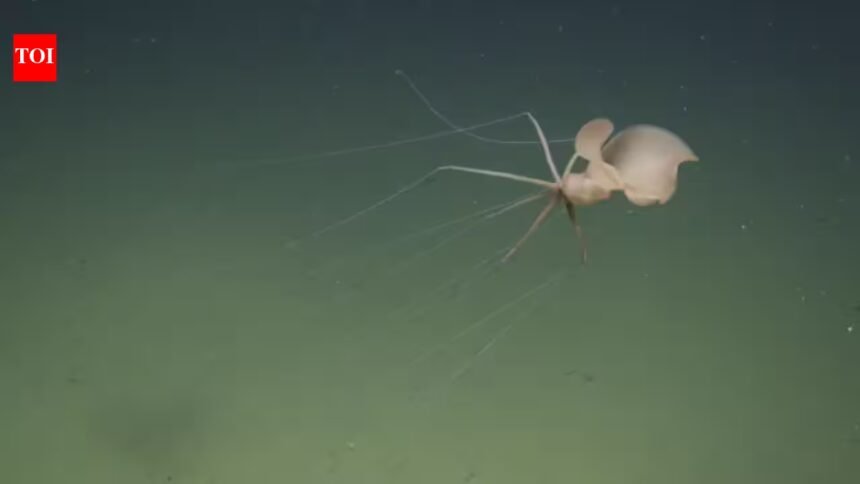
Two miles below the surface of the Pacific Ocean, off the coast of California, in a world of near total darkness and crushing pressure, a remotely operated vehicle glided silently through the water. Its cameras were scanning the deep for the strange and the seldom-seen when something extraordinary appeared on its screen. Long trailing arms and a ghostly body drifted into view: a bigfin squid, a species rarely seen alive. For the research team on the ship above, it was a moment of pure wonder. It was the first confirmed live sighting of a bigfin squid in the North-east Pacific, the Los Angeles Times reported, and gave scientists a rare glimpse of one of the ocean’s most elusive inhabitants. Read on to know more:Plunge into the depthsThe expedition was conducted in deep waters off the Central California coast, a region well known for its abundance of marine life and dramatic undersea topography. The research vessel lowered a remotely operated vehicle, or ROV, a robotic submersible piloted from the ship through a long tether. The ROV carries high-definition cameras, lights, and sampling tools that allow it to explore much deeper than a human diver could reach.As the ROV fell through the water column this time, it moved through the transition from where sunlight begins to disappear, then to where it disappears completely. At around two miles down, in the cold, dark expanse of the deep sea, the pilots were searching for organisms that live in this extreme environment. They expected to see strange fish, gelatinous creatures and perhaps a few unusual invertebrates. What they did not expect was to encounter one of the ocean’s most mysterious squids.The moment the bigfin appearedAs the ROV moved along a deep slope, the camera picked up a faint shape in the distance. It was difficult to see at first, a pale thing with long, thin tentacles trailing behind it. As the car got closer and its lights came on, details became visible. The thing was thin and long, and its arms and tentacles were of extraordinary length, trailing behind it to a most fantastic extent.For the scientists and pilots monitoring the feed, the sight was both startling and mesmerising. Bigfin squids, members of the genus Magnapinna, are known mostly from a handful of video clips and a few damaged specimens recovered from fishing nets or washed ashore. Most of those records come from other parts of the world, such as the Atlantic, Indian and western Pacific Oceans. To see one alive, and to do so in the Northeast Pacific, was unprecedented.What makes the bigfin squid so unusualBigfin squids stand out even among deep-sea cephalopods. Their most striking feature is their extremely long, thin arms and tentacles, which can be many times their body length. In other footage from other oceans, these limbs hang almost vertically in the water, creating a spooky, curtain-like effect. Scientists aren’t sure what the long tentacles are for, but they believe they may help the squid to sense or catch food in the deep, food-scarce waters.Their bodies are relatively small compared to the span of their arms, and they tend to drift or hover in the water column rather than swim actively. This slow, drifting behaviour, combined with their ghostly appearance, has earned them nicknames like “spooky squid” or “long arm squid” in popular accounts. Because they live so deep and are so fragile, they are rarely encountered intact, and rarely observed alive in their natural habitat.Why this sighting mattersThe Northeast Pacific is one of the most studied ocean regions in the world, yet it still holds major surprises. Many deep sea species have never been seen alive, and some are known only from fragments. Each new live observation adds crucial information about where species live, how they behave and how they fit into the broader ecosystem.This observation of a bigfin broadens the known distribution of the genus into California waters and suggests that these squids are more common than previously thought. It also provides researchers with high quality video to study posture, movement and interaction with the surrounding environment in detail. Observations made over time like this help build up a clearer picture of deep-sea biodiversity and the adaptations that allow life to thrive under extreme conditions.The technology that made it possibleNone of this happens without modern deep-sea robotics. The team relied on a remote sub built to handle crushing pressures miles beneath the surface while broadcasting crisp, real-time video. Soft lighting was engineered to light the pitch-black water just enough to show sharp details without scaring the local wildlife.When a rare bigfin squid drifted into view, shipboard pilots carefully manoeuvred the craft to hold steady rather than chase it. It was a gentle, non-intrusive way of getting amazing images for researchers without stressing the animal, showing why low-impact technology is so important when studying delicate deep-ocean ecology.A moment of wonder for the teamFor the crew on board, this was far more than just a data point. It was pure, spellbinding awe. Deep-sea research sits right at the intersection of hard science and childlike wonder, and this moment hit both notes. The pilots admitted they got so glued to their screens that they forgot they were steering a robot two miles beneath the surface.Moments like this explain why deep-ocean exploration still grips our imagination. Even in a world mapped by satellites, the deep sea remains largely pitch black and uncharted. Each dive is a thrill of discovery, a reminder of how much of our own planet is still hidden in the dark.What is nextResearchers are now going through the footage frame by frame, matching it up with global sightings to try and nail down the exact species, or to see if it’s a unique regional population. They’ll also share the video with marine scientists everywhere to help build a clearer picture of deep-ocean life.Beyond the science, clips like this bring a strange, hidden world directly into living rooms and classrooms. To see these creatures in the flesh makes a place most people will never visit feel real. That personal connection is important to galvanising public support for protecting vulnerable ocean habitats from deep-sea mining, aggressive fishing and climate change.A reminder of the ocean’s mysteriesThe bigfin squid did not set out to make history. It was simply living its life in the dark, drifting through water that humans have only begun to explore. Yet its brief appearance on camera reminds us how much of the ocean remains a frontier. New species, new behaviours and new ecosystems are still being discovered, often in places we once thought we understood.For the scientists who witnessed it, the sighting will be a highlight of their careers. For the rest of us, it is an invitation to imagine what else might be out there, waiting in the deep, just beyond the reach of our lights.